




Most people only think about seat cushions in two places: the office chair and the car seat. But pressure on your tailbone and sit bones doesn’t check your location before it starts to hurt—it shows up anywhere you’re stuck on a hard, unsupportive surface for more than an hour or two. Below are three everyday situations where a cushion solves a problem most people just tolerate, plus which type of seat actually benefits from one.
Quick Reference: Which Situation, Which Cushion
| Situation | Best Cushion Type | Why | Product |
|---|---|---|---|
| Gaming chairs, long streaming sessions | U-shaped cutout | Removes direct tailbone pressure during unbroken multi-hour sessions | Office Seat Cushion |
| Stadiums, concerts, trains | Full-size cutout with carrying handle | Generous seat width, easy to carry along | Office or Car Seat Cushion |
| Economy airline seats | Often none, or a compact option | Limited seat width and legroom work against a full-size cushion | Consider skipping for short flights |
| Dining chairs, everyday home seating | U-shaped cutout | General, all-day tailbone relief on hard surfaces | Office Seat Cushion |
| Recovery, postpartum, hemorrhoids | Open-center donut | Removes pressure entirely from the sensitive area, not just redistributes it | Donut Cushion |
Scenario 1: Gaming Chairs and Long Streaming Sessions
That gaming chair with the racing stripes and adjustable armrests? Underneath the branding, it’s often the same flat foam as a budget office chair—just dressed up to look like performance gear. And the pain it causes is real: a 2026 systematic review and meta-analysis of esports players found that 73% had experienced musculoskeletal pain in the past year, with the spine the most commonly affected area and nearly half reporting neck pain specifically.
The reason gaming sessions hit harder than a typical workday isn’t just the chair—it’s the sitting pattern. Office workers get interrupted by meetings, coffee runs, and walks to the printer. Gamers, especially mid-match or mid-stream, tend to push through to a natural stopping point instead of a scheduled one, which often means hours of unbroken pressure on the same spot.
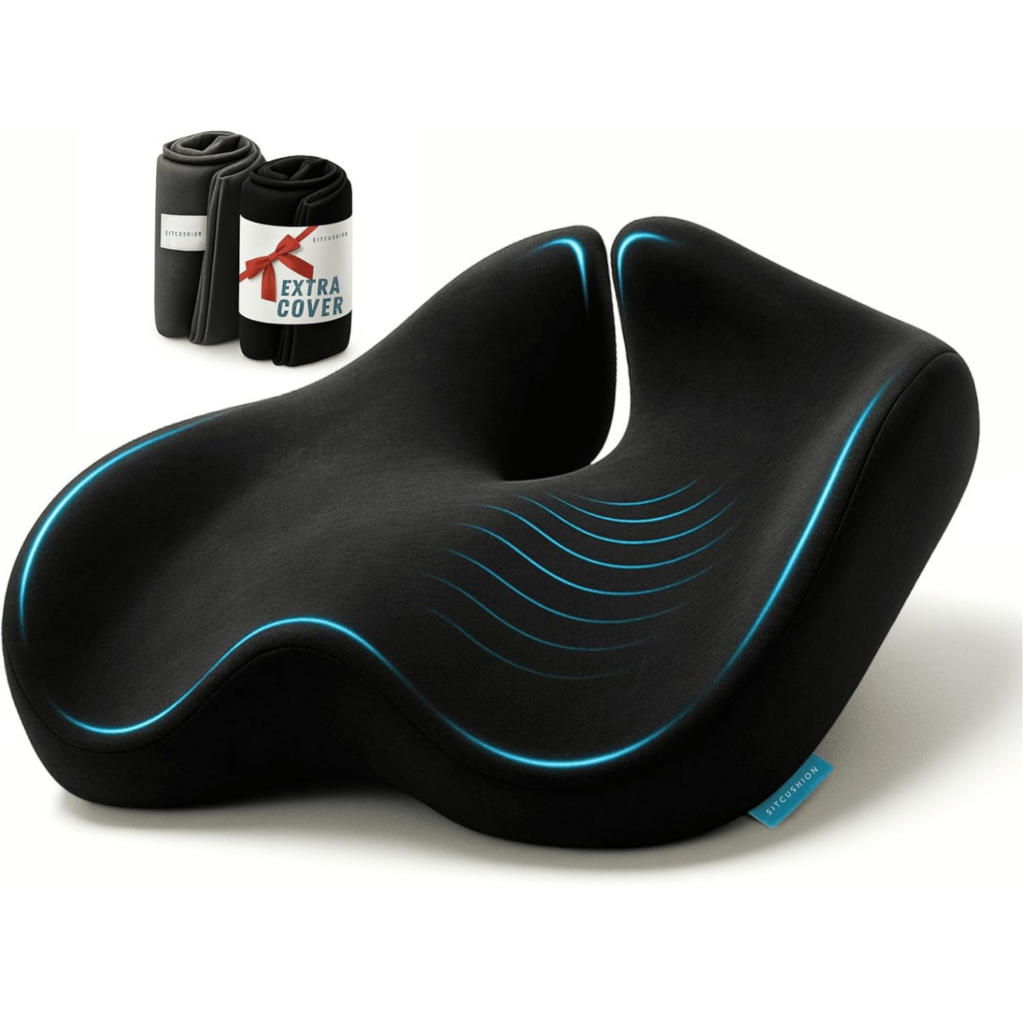
The fix doesn’t require a gaming-specific product. A cushion with a coccyx cutout relieves the exact same pressure points during a six-hour raid or a marathon stream as it would during a workday—and because most gaming chairs use a standard seat width, the Office Seat Cushion drops in without any modification.
Scenario 2: Travel — Planes, Trains, Stadiums, and Concert Seats

Public seating is designed for turnover, not comfort. Stadium benches, train seats, and economy airline seats all use thin, hard-wearing padding meant to survive thousands of sitters a year—not to support any single one of them for a three-hour flight or a full nine-inning game. The result is the same tailbone pressure you’d get from a bad desk chair, just in a setting where you can’t get up and stretch whenever you want.
A portable cushion solves this well in some settings and less well in others, so it’s worth being specific. For stadiums, concert venues, and trains—where seat width is generous and you’re carrying a bag anyway—a full-size cushion with a carrying handle, like the Car Seat Cushion, works exactly as it does at home. For economy airline seats, where legroom and seat width are both tight, a large cushion can be more hassle than help; in that case, sizing down or accepting that a cushion isn’t the right tool for that specific seat is the more honest answer than forcing a product to fit where it doesn’t.
The takeaway: match the cushion to the seat, not the other way around. A little research into your specific venue or airline’s seat dimensions before you travel saves you from carrying support you can’t actually use.
Scenario 3: Everyday Chairs at Home — Dining Chairs, Recovery, and Aging in Place
The cushion conversation almost always focuses on work and driving, but some of the hardest seats in most homes are the ones nobody thinks to fix: wooden dining chairs, kitchen stools, and folding chairs for guests. If dinner regularly turns into an hour or more at the table—working from the kitchen, hosting family, or just a long meal—that’s enough time for the same pressure buildup as a desk chair, just in a spot nobody budgets extra comfort for.
Two groups benefit even more than the average diner. People recovering from minor tailbone injuries, hemorrhoids, or childbirth often need a cushion at every seat they use during the day, not just at a desk—which is exactly the situation the open-center donut design is built for, since it removes direct pressure from the area that’s actually sensitive rather than just adding general padding. And older adults who spend more of the day seated at home, often in chairs that were never designed with pressure relief in mind, tend to feel the benefit of a cutout cushion more, not less, than someone who’s only sitting for a typical workday.
The practical upside here is that a single cushion can move around the house as needed—dining chair for dinner, an armchair for reading, a folding chair when guests come over—since none of these situations require anything more specialized than the same design already covers.
The Bottom Line
Tailbone pressure doesn’t stay within office hours. It follows you into a six-hour gaming session, a cross-country flight, a stadium bench, or your own dining room chair—any surface that’s hard, unsupportive, and held for longer than an hour or two. The fix is the same principle each time: take direct pressure off the tailbone and sit bones, whether that’s during a late-night raid, a long trip, or dinner with family.
If one of these situations sounds familiar, our seat cushion comparison guide breaks down which design—including the donut cushion for post-injury or postpartum recovery—fits your specific chair and your specific need.
Frequently Asked Questions
Does the same seat cushion work for gaming chairs, travel, and dining chairs, or do I need a different one for each?
The same cutout design works across all of these, since the underlying problem—concentrated pressure on the tailbone and sit bones—is identical regardless of the chair. The main variable is size: a full-size cushion is fine for gaming chairs, stadium seats, and dining chairs, but tight spaces like an economy airline seat may not accommodate one comfortably.
What’s the best option for an economy airline seat?
Honestly, a full-size cushion is often more hassle than help in a tight economy seat, since limited legroom and seat width work against it. If you’re flying economy, consider whether the flight is long enough to justify carrying one, or save the cushion for the wider seats—stadiums, trains, and dining chairs—where it fits without a fight.
Is a cushion really necessary for a dining chair, or is that overkill?
It depends on how long you’re actually sitting. An hour-long dinner occasionally isn’t the same as working from the kitchen table for a full day, hosting long family gatherings, or being in recovery and needing to sit at every meal. In those higher-duration cases, the same pressure buildup that happens at a desk happens at the dining table—so the same solution applies.
Why do donut cushions come up specifically for recovery and postpartum use?
Because the mechanism is different from a general cutout cushion. A donut design has a fully open center, which removes direct pressure from a specific sensitive area entirely—rather than just redistributing weight more broadly. That’s why it’s the more targeted choice for hemorrhoids, postpartum recovery, or minor tailbone injuries, while a U-shaped cutout is better suited to general, all-day tailbone relief.