







The best wheelchair cushion for an elderly user is the one that matches their skin risk and how long they sit. For comfort-focused use with healthy skin, a contoured foam or gel-foam cushion is usually enough. For long hours in the chair, limited ability to shift position, or any history of pressure sores, a gel, air-cell or hybrid cushion that has been fitted by a therapist is the safer choice.
An older adult who spends most of the day in a wheelchair needs more from a cushion than softness. It has to spread pressure away from the tailbone and sitting bones, keep the skin cool and dry, hold the hips in a stable position, and stay in place during transfers.
This guide explains how foam, gel, air and hybrid cushions differ, what matters most for pressure relief, back pain and long sitting hours, how to measure for a good fit, and how veterans and people with a spinal cord injury should approach the choice. It is educational information, not medical advice. Anyone at high risk of pressure injury should have their seating reviewed by a physical or occupational therapist.
How to Choose a Wheelchair Cushion for an Elderly User
The best wheelchair cushion for an older adult depends on three things: their risk of pressure injuries (also called pressure sores or bedsores), how many hours a day they sit, and how well the cushion fits their wheelchair. Comfort matters, but for anyone who sits for long stretches, skin protection comes first.
Match the Cushion to Pressure Injury Risk
A cushion that feels fine for the first hour may not protect the skin over a full day. Risk goes up when someone has had a previous pressure sore, has reduced feeling in the hips or legs, cannot easily shift their weight, or has thin, fragile or often-damp skin.
| Risk level | Typical situation | What to look for |
|---|---|---|
| Lower | Healthy skin, sits a few hours at a time, changes position easily | Contoured high-density foam or gel-foam cushion with a washable cover |
| Moderate | Sits many hours, limited weight shifts, sensitive skin | Gel or hybrid cushion with good pressure redistribution, ideally with input from a therapist |
| Higher | Past pressure sore, reduced feeling, spinal cord injury, or unable to reposition alone | Air-cell or hybrid pressure redistribution cushion chosen after a professional seating evaluation |
This table shows general patterns, not a prescription. The international pressure injury guideline, developed by the National Pressure Injury Advisory Panel (NPIAP) with its European and Pan Pacific partners, found moderate-certainty evidence that a pressure redistribution cushion can help prevent new pressure injuries compared with a cushion without those properties. Most participants in the studies it reviewed were older adults using wheelchair cushions. The same guideline recommends choosing seating after a seating and wheelchair evaluation, so for higher-risk users, ask the doctor for a referral to an occupational therapist (OT) or physical therapist (PT) who performs seating evaluations.
Consider How Long the Person Sits and How Often They Move
The longer someone stays in one position, the more important pressure redistribution becomes, and a cushion works best alongside regular repositioning. Older adults who cannot shift their weight on their own may need caregiver help or a power tilt wheelchair. The Model Systems Knowledge Translation Center notes in its guidance for wheelchair users with spinal cord injury that tilt and recline features can provide pressure relief, and that users should receive training from a health care provider to be sure they are getting enough of it. Heat and moisture matter too, so look for a breathable, moisture-resistant cover.
Check Fit and Stability
A cushion that is too wide, too deep or too thick can cause problems of its own. The guideline warns that a pressure redistribution cushion that is not fitted to the person and the seat may lead to pressure injuries, instability or falls. Before buying, measure the seat’s width and depth in inches, check that the added thickness does not leave the person too high for the footrests or a table, and look for a non-slip base, a removable washable cover, and a weight capacity that matches the user.
Foam, Gel, Air and Hybrid Wheelchair Cushions Compared
Wheelchair cushions fall into four main types: foam, gel, air and hybrid. Foam is the most affordable and stable, gel and air redistribute pressure better, and hybrids combine materials to balance the two. No single type is best for everyone, so the right one depends on skin risk, sitting time, and how much maintenance the user or caregiver can handle.
| Type | How it works | Strengths | Trade-offs | Best suited for |
|---|---|---|---|---|
| Foam | Contoured or flat foam conforms to the body | Affordable, lightweight, stable, easy to find | Loses shape over time, can trap heat and moisture, redistributes pressure less than gel or air | Lower-risk users who sit a few hours at a time |
| Gel | Gel pouches, usually over a foam base | Better pressure distribution than foam, cooler surface | Heavier, often costs more, can leak if damaged | Moderate-risk users who sit for long periods |
| Air | Interconnected air cells that can be adjusted | Excellent pressure redistribution, adjustable firmness, lightweight | Needs regular inflation checks, can puncture, transfers can be harder | Higher-risk users, usually after a seating evaluation |
| Hybrid | Foam base with gel or air in key areas | Stability of foam plus targeted pressure relief | Costs more than basic foam, more parts to care for | Users who need both support and pressure relief |
Is Memory Foam Good Enough for a Wheelchair Cushion?
For lower-risk users, a high-density contoured foam or gel-foam cushion is often enough. Memory foam can be comfortable and supportive for someone with healthy skin who sits for a few hours and shifts position easily. For someone who sits most of the day, has had a pressure sore, or cannot reposition independently, foam alone is usually not enough. That user should have a seating evaluation and likely needs a gel, air or hybrid cushion with proven pressure redistribution.
Which Type Is Most Effective for Pressure Relief?
A published rapid review of studies in people with spinal cord injury found that air cushions reduced interface pressure more consistently than gel or foam, but it also noted that studies differ and that individual pressure measurement is the best way to choose. In practice, the “best” cushion is the one that tests well for that person in their own wheelchair.
Practical Tips for Any Cushion Type
- Replace foam cushions when they flatten or lose their contour, even if the cover still looks fine.
- Keep a backup cushion on hand if you use gel or air, since these can leak or puncture.
- Check air cushion inflation regularly, because under-inflated cells can leave the sitting bones with too little protection.
- Clean the cover often and let it dry fully, especially for users with incontinence or heavy sweating.
Best Wheelchair Cushion for Long Hours of Sitting and Back Pain

For long hours in a wheelchair, the most comfortable cushion is one that spreads pressure evenly, keeps the hips level and stable, stays cool and dry, and fits the chair precisely. A cushion can reduce discomfort and support better posture, but it cannot fix back pain by itself. Seat cushion, back support and the person’s sitting position work together as one seating system.
What Makes a Wheelchair Cushion Comfortable for All-Day Use
Comfort over a full day depends less on softness and more on support and stability. A cushion that feels plush at first can flatten, let the pelvis tilt, or trap heat after a few hours. For long sitting, look for these features:
- Pressure redistribution that eases load on the tailbone and sitting bones, with enough contour to keep the hips centered.
- Stable shape that holds up over months of daily use, with a firm base so the person does not “bottom out.”
- Breathable, moisture-resistant cover that is removable and washable, especially for users who sweat or have incontinence.
- Non-slip base that keeps the cushion from shifting during transfers and while the chair moves.
- Correct size and thickness for the seat, so the person is not lifted too high or pushed forward.
Wheelchair Cushions and Back Pain
Back pain in wheelchair users often comes from posture more than padding. When the pelvis slides forward or tilts, the spine rounds to compensate, and muscles tire over hours. A contoured cushion that holds the pelvis in a neutral position can reduce that strain, and lateral support may help users who lean to one side. A cushion that is too soft or too thick can make posture worse by letting the pelvis sink unevenly.
Seat Cushions vs Wheelchair Back Cushions
Many standard wheelchairs have a sling-style back that sags with use, which encourages slouching. A back support or back cushion can add contour and lumbar support, but it should be chosen together with the seat cushion, not on its own. The international pressure injury guideline advises reviewing back supports in conjunction with the seat cushion and other supports, so the whole system delivers postural support, comfort and pressure redistribution together.
When Back Pain or Discomfort Needs a Professional Look

A new cushion should not be expected to solve every symptom. Ask a doctor or occupational therapist (OT) to review the seating if the person has pain that is new, worsening or constant, numbness or tingling, redness on the skin that does not fade, trouble staying upright, or a tendency to slide or lean. These can signal a posture or fit problem, or an early sign of skin damage, that a different cushion or chair adjustment can address.
Does Medicare Cover Wheelchair Cushions, and How Can Veterans Get One
Original Medicare (Part B) can cover a wheelchair seat cushion, but only when the person has a Medicare-covered wheelchair and meets the coverage criteria for that type of cushion. Veterans enrolled in VA health care may be able to get a wheelchair and cushion through the VA when a VA clinician determines the equipment is medically needed. Rules and eligibility can change, so confirm details with Medicare or the VA before buying.
Medicare Coverage for Wheelchair Seat Cushions
Medicare sorts wheelchair cushions into categories, and each has its own requirements. Under the CMS wheelchair seating guidance, coverage works like this:
- General-use seat cushion. Covered for a person who has a manual wheelchair, or a power wheelchair with a sling or solid seat, that meets Medicare criteria. If the person does not have a Medicare-covered wheelchair, the cushion is denied.
- Skin protection seat cushion. Requires a Medicare-covered wheelchair and either a current or past pressure sore where the body contacts the seat, or absent or impaired sensation there, or an inability to carry out a functional weight shift.
- Positioning seat cushion. Requires a Medicare-covered wheelchair and significant postural asymmetries linked to a qualifying diagnosis.
- Custom-fabricated cushion. Considered when the person meets the criteria above and a physical or occupational therapist documents why a ready-made cushion does not meet their needs. The therapist cannot have a financial relationship with the supplier.
Medicare also requires a face-to-face visit and a written order before the items are delivered. A seat or back cushion for a transport chair is not covered under these rules, which matters for older adults who use a transport chair rather than a standard wheelchair. People usually pay the Part B deductible and 20% of the Medicare-approved amount for equipment, and the supplier must be enrolled in Medicare. Medicare Advantage plans may add their own requirements, such as in-network suppliers or prior authorization, so check the plan first.
How Veterans Can Get a Wheelchair Cushion Through the VA
The VA’s Prosthetic and Sensory Aids Service (PSAS) provides a full range of equipment and services to Veterans, including wheelchairs and other durable medical equipment. Eligibility generally starts with enrollment in VA health care and a clinician’s assessment of medical need.
For a Veteran who sits in a wheelchair for long periods, the practical path is:
- Ask the VA primary care provider or the physical medicine and rehabilitation (PM&R) team for a seating evaluation.
- Describe hours of sitting per day, any skin problems or past pressure sores, pain, and difficulty shifting position.
- Have the VA team submit the request to Prosthetics, and contact the local PSAS office through the VA facility locator with questions about eligibility.
Getting the cushion through VA or Medicare has a clear advantage: the cushion is chosen after a clinical evaluation, which is what higher-risk users need most.
Wheelchair Cushion vs Regular Seat Cushion for Elderly Users

A wheelchair cushion is built to fit a wheelchair seat and manage pressure over long hours, while a regular seat cushion is designed mainly for comfort on chairs, car seats and recliners. For an older adult who spends most of the day in a wheelchair, a wheelchair-specific cushion is usually the better choice. For someone who uses a wheelchair or transport chair only now and then, a comfort seat cushion can be a practical, affordable option.
Key Differences at a Glance
| Feature | Wheelchair cushion | Regular seat cushion |
|---|---|---|
| Main purpose | Pressure redistribution, positioning and stability in a wheelchair | Comfort and ergonomic support on everyday seating |
| Common materials | Foam, gel, air or hybrid construction | Memory foam, often with a tailbone cutout |
| Sizing | Made in standard wheelchair seat widths and depths | Sizes vary by product, so measure before use |
| Best for | Long sitting hours, skin risk, positioning needs | Short to moderate sitting, healthy skin, easy position changes |
| Insurance | May be covered when Medicare or VA criteria are met | Usually paid out of pocket |
When a Regular Seat Cushion Can Make Sense
A regular seat cushion can work well for an older adult who:
- Uses a wheelchair or transport chair for short outings and sits in other chairs for most of the day.
- Has healthy skin, no history of pressure sores, and can shift position without help.
- Needs extra comfort for a dining chair, recliner or car seat in addition to the wheelchair.
- Uses a transport chair, where Medicare does not cover a seat cushion, so the cost comes out of pocket.
One example of a comfort-focused option for these everyday situations:
A Comfort Option for Everyday Seating
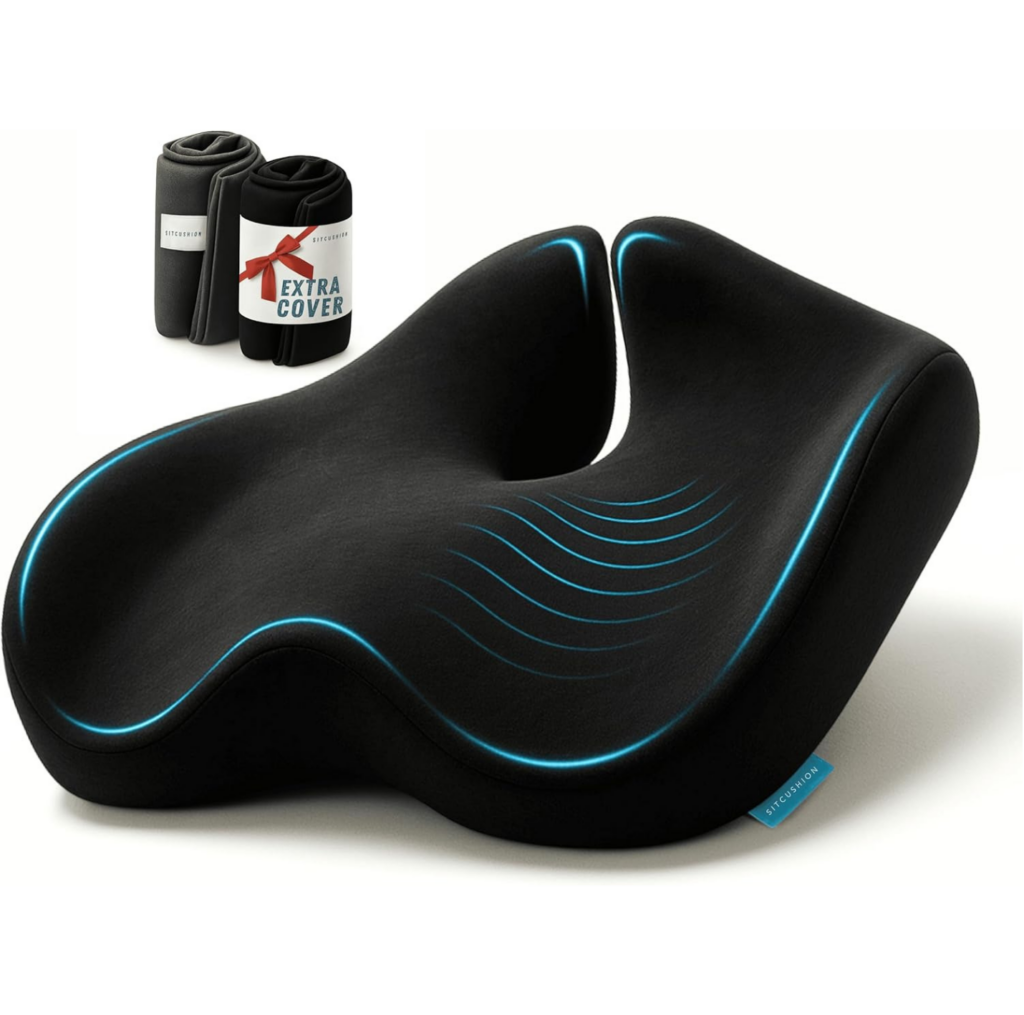
Sitcushion Office Seat Cushion
U-shaped cutout, charcoal-infused memory foam, non-slip base and a washable cover. Lifetime money-back guarantee.
When to Choose a Wheelchair Cushion Instead
Choose a wheelchair-specific cushion when the person sits for many hours a day, has had a pressure sore, has reduced feeling in the hips or legs, cannot shift weight independently, or needs positioning support for posture. These users benefit most from a cushion selected through a seating evaluation, and they are the ones Medicare and the VA are set up to help.
Tips for Using Any Cushion on a Wheelchair Seat
- Measure the seat’s width and depth in inches, and check that the cushion’s thickness does not leave the person too high for the footrests or a table.
- Look for a non-slip base so the cushion stays put during transfers.
- Check the skin daily. Redness that does not fade within a short time, new soreness or skin breakdown should prompt a call to the doctor or occupational therapist.
- Avoid stacking several cushions, which can reduce stability.
Frequently Asked Questions About Wheelchair Cushions for Elderly Users
What is the best wheelchair cushion for elderly users?
The best wheelchair cushion is the one that matches the person’s skin risk and how long they sit. For healthy skin and a few hours of sitting, a contoured high-density foam or gel-foam cushion is usually enough. For long hours, a past pressure sore, or trouble shifting position, a gel, air or hybrid pressure redistribution cushion chosen with an occupational or physical therapist is the safer choice.
What is the best wheelchair cushion for sitting long periods?
For long sitting, look for pressure redistribution, a stable contoured shape, a breathable washable cover, a non-slip base and the right size for the seat. Gel, hybrid or air cushions are usually better than basic foam for many hours a day. Even the best cushion works better when the person also changes position regularly.
What is the best pressure relief cushion for a wheelchair?
A review of studies in people with spinal cord injury found that air cushions lowered pressure more consistently than gel or foam, though results varied between studies. For most people, the best pressure relief cushion is the one that tests well for them in their own wheelchair, which is why a seating evaluation matters. A cushion does not replace regular weight shifts.
What is the most comfortable wheelchair cushion?
Comfort over a full day comes from support and stability, not just softness. A contoured foam or gel-foam cushion with a breathable cover is comfortable for many users. A cushion that is too soft can let the pelvis sink and tilt, which often leads to back and hip discomfort after a few hours.
What is the best back cushion for a wheelchair?
Look for a back support with contour and lumbar support, chosen together with the seat cushion so the whole system holds the pelvis and spine in a neutral position. Many wheelchairs have a sling back that sags and encourages slouching. If back pain continues, ask a doctor or occupational therapist to review the seating.
How can I make a wheelchair more comfortable?
Start with the right cushion for the person’s skin risk and sitting time, then add a supportive back cushion if the sling back sags. Use a non-slip base so the cushion stays in place, keep the cover clean and dry, and make sure the added thickness does not throw off footrest or table height. Change position often, and check the skin daily for redness that does not fade.
What is the best cushion for a wheelchair-bound person?
Someone who uses a wheelchair full time should have a seating evaluation before choosing a cushion. Foam alone is usually not enough for all-day use. A gel, air or hybrid cushion with good pressure redistribution is more common, and Medicare or the VA may help pay when criteria are met.
What is the best wheelchair cushion for spinal cord injury?
Reduced sensation raises the risk of pressure injuries, so people with spinal cord injury usually need a pressure redistribution cushion, often air, gel or hybrid. Research reviews suggest measuring pressure for the individual rather than relying on cushion type alone. Choose with a physical or occupational therapist who can test the cushion in the person’s own wheelchair.
How do I keep a cushion from sliding on a wheelchair seat?
Choose a cushion with a non-slip base, or place a non-slip mat or material under it, such as Dycem-type matting. Make sure the cushion fits the seat width and depth, and avoid stacking several cushions. If the person keeps sliding forward even with a good cushion, ask an occupational therapist to check posture and seating.
What is the best seat cushion for elderly people in a regular chair?
For a dining chair, recliner or car seat, look for a medium-firm contoured foam cushion with a non-slip base and a washable cover. Very soft cushions can make it harder to stand up, so choose one that supports without sinking deeply. Measure the seat first so the cushion fits.
What does “medical grade” mean for a wheelchair cushion?
“Medical grade” is not a standardized label for seat cushions, so it does not guarantee pressure relief. Look instead at how the cushion is categorized and evaluated. Medicare, for example, separates general-use, skin protection and positioning cushions and sets different criteria for each.
Does Medicare cover wheelchair cushions?
Medicare Part B can cover a wheelchair seat cushion when the person has a Medicare-covered wheelchair and meets the criteria for that cushion type. Skin protection cushions require a current or past pressure sore, impaired sensation, or inability to shift weight. A face-to-face visit and written order are required, and a cushion for a transport chair is not covered.
Can veterans get a wheelchair cushion through the VA?
Veterans enrolled in VA health care may be able to get a wheelchair and cushion through the VA’s Prosthetic and Sensory Aids Service when a VA clinician finds a medical need. Start by asking the VA primary care or rehabilitation team for a seating evaluation, and contact the local VA Prosthetics office with eligibility questions.
Choosing the Right Wheelchair Cushion for an Elderly Loved One
The right wheelchair cushion for an older adult comes down to three things: skin risk, sitting time and fit. Comfort matters, but for anyone who spends long hours in a wheelchair, pressure redistribution and proper sizing come first.
Key Takeaways
- Match the cushion to risk. Foam or gel-foam can work for lower-risk users. Gel, air or hybrid cushions are better for long hours or higher skin risk.
- Get a seating evaluation from a doctor, occupational therapist (OT) or physical therapist (PT) if the person has had a pressure sore, has reduced feeling, or cannot shift position alone.
- Fit matters as much as material. Measure the seat, check thickness against footrest and table height, and choose a non-slip base and washable cover.
- A cushion works with movement. Regular weight shifts, tilt or caregiver help, and daily skin checks remain part of prevention.
- Check coverage first. Medicare Part B and the VA may help pay when criteria are met, which can make a professionally selected cushion more affordable.
What to Do Next
Start by noting how many hours a day the person sits, whether they can shift position on their own, and any skin problems or pain. Bring that information to the doctor or therapist, and ask about a seating evaluation and coverage through Medicare or the VA. If comfort on other seats is also a concern, our guide to the best seat cushions for pain relief and comfort covers everyday options. If the person also needs help getting in and out of a vehicle, see our wheelchair transfer techniques, and browse the full Knowledge Center for more practical sitting guides.