Skip to content
1. Purpose and Audience
This report is written for professional and aspiring e-sports athletes, coaches, healthcare professionals, and product designers who support high-performance gaming. Its goal is to explain how prolonged competitive gaming affects spinal and pelvic mechanics and to outline ergonomic strategies that reduce mechanical load without making medical claims.
2. Executive Summary
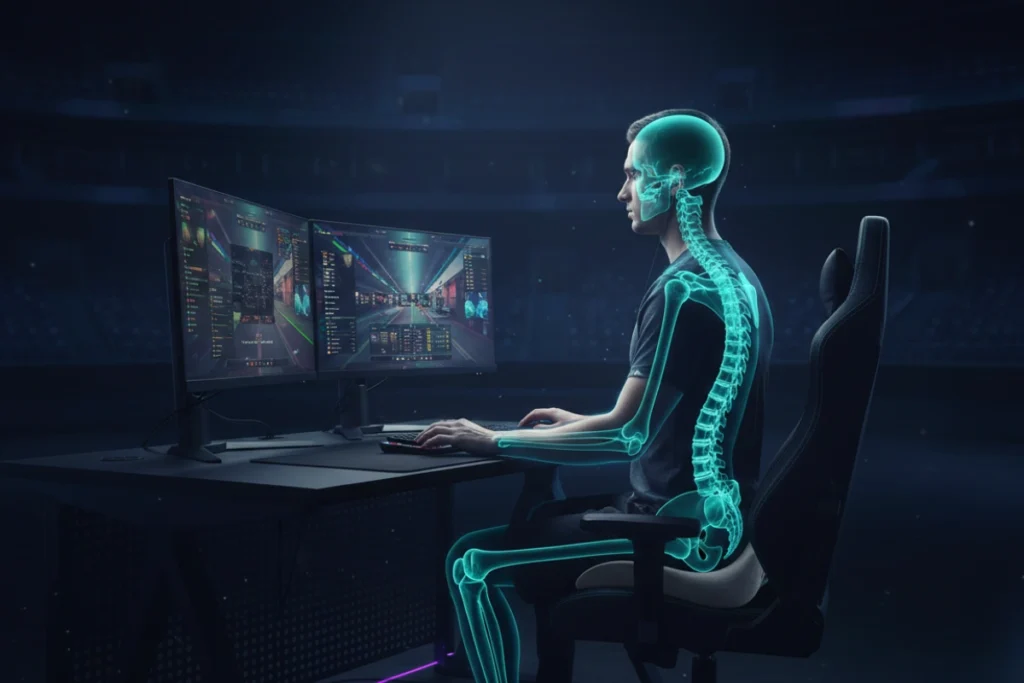
High-performance e-sports training exposes players to long periods of static sitting with high visual and motor demands. Unlike typical office work, competitive gaming often requires postural fixation—sustained isometric muscle activity used to preserve visual precision and reaction consistency on high-frame-rate displays. Observational data and player reports indicate a high prevalence of mechanical discomfort, especially in the cervical and lumbar regions.
This report describes how spinal and pelvic load is distributed during prolonged gaming, how postures such as forward head posture and pelvic retroversion alter intradiscal pressure and muscular demand, and how seating materials influence long-term support. It then translates these biomechanical insights into an ergonomic decision framework that can guide workstation design, gaming chair configuration, and training routines for extended sessions.
3. Key Biomechanical Definitions
To standardize terminology, these definitions will be used throughout the report.
- Intradiscal Pressure (IDP)
The internal hydrostatic pressure within the intervertebral disc. IDP varies with posture; flexed or slouched positions generally increase mechanical load on the nucleus pulposus compared with neutral alignment. - Lumbar Lordosis
The natural inward (concave) curvature of the lumbar spine. Supporting this curvature is a central goal of seated ergonomics because it promotes more even axial load distribution along the vertebral column. - Neutral Pelvis
An alignment in which the Anterior Superior Iliac Spine (ASIS) and Posterior Superior Iliac Spine (PSIS) are level in the sagittal plane. This neutral orientation provides a mechanical foundation for the physiological spinal curves. - Pelvic Retroversion
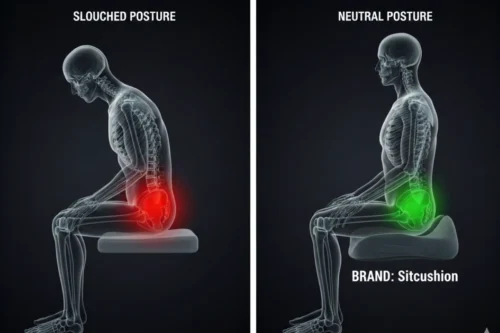
A posterior (backward) tilt of the pelvis. In seated gaming, pelvic retroversion is linked to flattening of the lumbar curve, migration toward a C-shaped spinal configuration, and potentially increased disc pressure and passive tissue strain. - Ischial Tuberosities
The “sitting bones” of the pelvis, structurally suited to bear the majority of body weight in a neutral upright sitting posture. In a well-aligned seat, load is centered over these structures rather than the sacrum or coccyx. - Craniovertebral Angle (CVA)
An angular measure of head posture, formed by a horizontal line through the C7 vertebra and a line connecting the C7 spinous process to the ear’s tragus. A smaller CVA is commonly used as an objective indicator of forward head posture.
4. Clinical Conditions vs. General Postural Fatigue
Distinguishing reversible mechanical fatigue from diagnosable pathology is essential for athlete management.
- Mechanical or postural fatigue
- Arises from prolonged static loading of muscles, ligaments, and joint capsules.
- Typical symptoms: localized soreness, muscular tenderness, stiffness, or moderately restricted mobility.
- Usually responds to: postural variation, breaks and micro-movements, improved mechanical support, and workload modulation.
- Diagnosable pathology
- Involves identifiable structural changes, altered joint mechanics, or neural involvement.
- Examples:
- Sacroiliac Joint Dysfunction (SIJD): hypermobility or hypomobility of the sacroiliac joint that may contribute to chronic low back pain.
- Radicular syndromes: nerve root compression producing pain, numbness, or weakness along a dermatomal distribution.
- These conditions require clinical assessment and are outside the scope of ergonomic interventions alone.
Ergonomic strategies in this report are intended to manage mechanical loading and support neutral alignment. They do not diagnose, treat, or prevent medical conditions and must be integrated with professional healthcare guidance where indicated.
5. Cervical Biomechanics: Forward Head Posture
5.1 Load Distribution
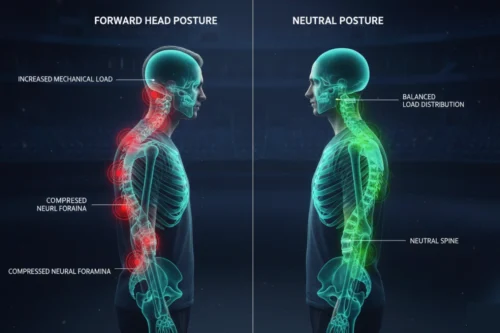
Forward Head Posture (FHP) shifts the head’s center of gravity anterior to the cervical spine, increasing the moment arm and mechanical demand on posterior structures. Under neutral alignment, passive structures and low-level muscular activity can stabilize the head with relatively low energy cost. As the head drifts forward, posterior cervical and upper thoracic muscles must generate higher counter-forces; even small increments of neck flexion can substantially increase effective load on the upper back and neck in biomechanical models.
5.2 Segmental Adaptation
Chronic FHP is often characterized by:
- Relative extension at upper cervical segments (C0–C2).
- Relative flexion at lower cervical segments (C2–C7).
This pattern reflects a compensatory strategy that allows gamers to maintain visual contact with the monitor while the overall head position drifts anteriorly. Over time, this may promote tissue overload, muscular fatigue, and altered proprioception.
5.3 Neural Considerations
Finite element and imaging-based models suggest that anterior head displacement can be associated with narrowing of neural foraminal spaces in the upper cervical region. This narrowing may influence structures such as the C2 nerve root and greater occipital nerve in susceptible individuals. While such changes are not equivalent to clinical diagnosis, they help explain why some players with pronounced FHP report headaches, upper cervical discomfort, or occipital symptoms.
5.4 Implications for Competitive Gaming
Forward head displacement transfers load-bearing responsibility from skeletal alignment to posterior musculature. In the context of long gaming sessions, this accelerates fatigue, may degrade fine motor control, and can potentially influence visual-motor performance if discomfort or stiffness becomes pronounced.
6. Pelvic Mechanics and Lumbar Integrity
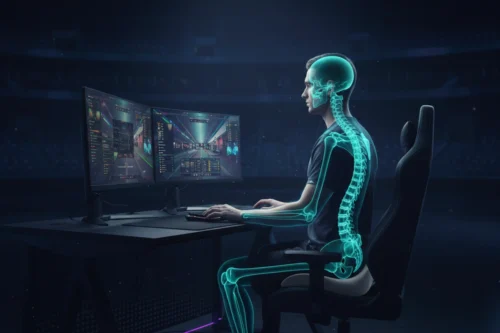
The pelvis acts as the kinetic foundation for the spine; its orientation shapes lumbar lordosis and, indirectly, cervical and thoracic alignment.
6.1 Intradiscal Pressure Variability
Early in vivo data suggested that upright sitting increased intradiscal pressure compared with standing. More recent work indicates that IDP in sitting can be comparable to or even lower than standing when:
- Back support is used effectively.
- Trunk and hip muscles are not in high tonic contraction.
Thus, sitting is not inherently more harmful than standing; the distribution of support and the degree of muscular activation are key determinants of disc loading.
6.2 Pressure Concentration and Slouched Posture
When players adopt a slouched posture:
- Pelvic retroversion increases.
- Load migrates from the ischial tuberosities toward the sacrum and coccyx.
- Lumbar lordosis tends to flatten, moving the spine closer to a global C-shaped configuration.
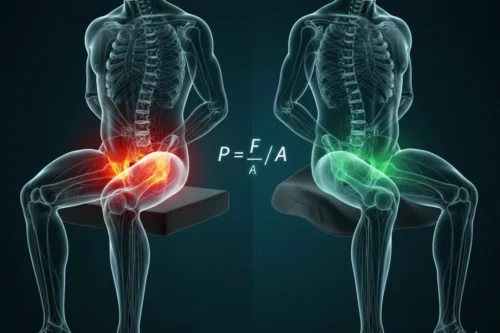
Because the sacrum and coccyx are not optimized for primary weight-bearing, this shift concentrates pressure and may increase stress on passive structures, accelerating discomfort during long sessions.
6.3 Recline Dynamics and “Active Recline”
Reclining the backrest can reduce intradiscal pressure by transferring a portion of upper body weight into the chair. For high-intensity gaming, a practical compromise is an Active Recline:
- Moderate recline (approximately 100–110 degrees hip–trunk angle, depending on the individual and equipment).
- Sufficient backrest contact to offload the spine.
- Monitor height and distance adjusted to avoid the need for forward lean.
This configuration aims to balance spinal offloading with the visual precision and rapid upper limb control required in competition.
6.4 Neutral Pelvic Stabilization
Maintaining a neutral pelvis:
- Helps preserve natural lumbar lordosis.
- Reduces reliance on sustained isometric contraction of deep spinal extensors.
- Minimizes strain on posterior ligaments and joint capsules.
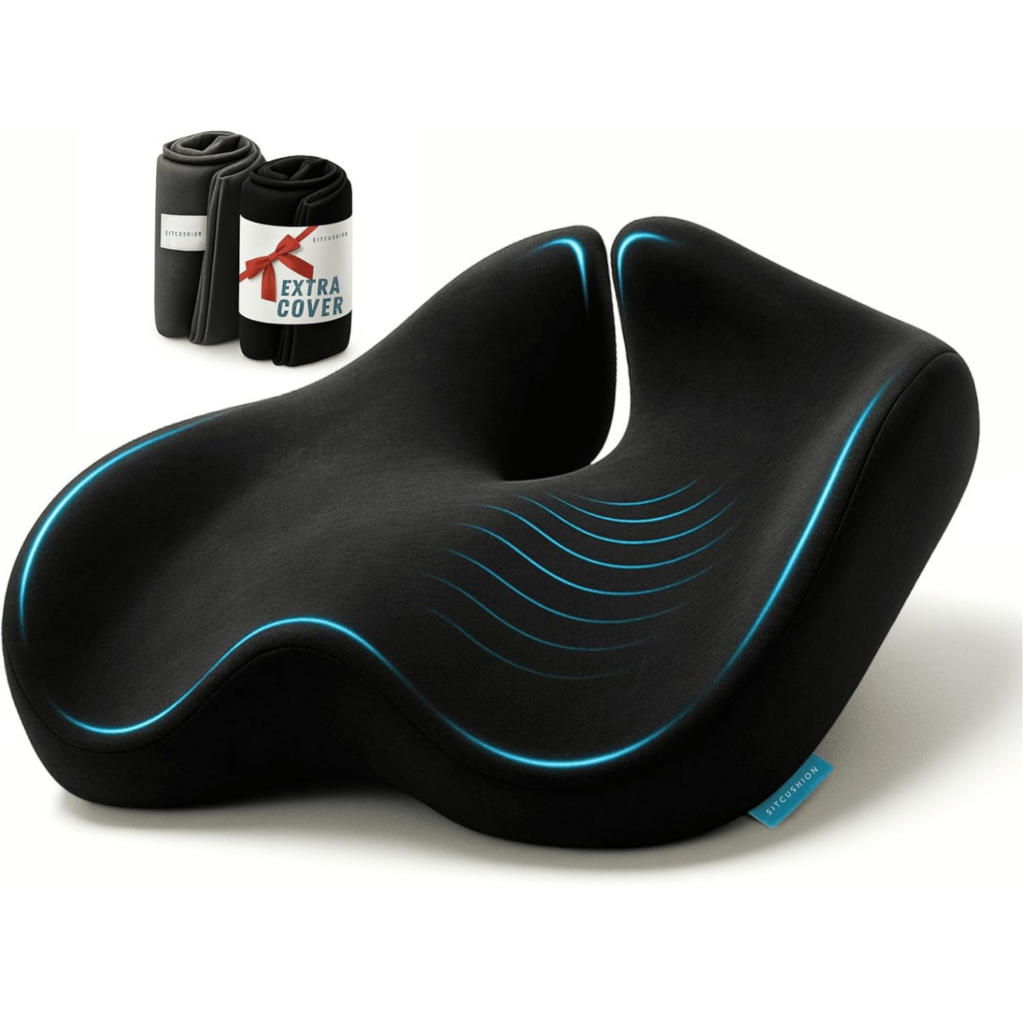
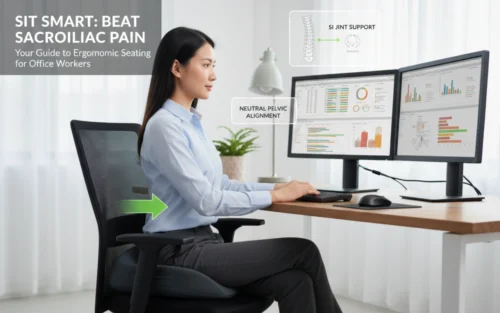
Design features such as shaped seat pans, pelvic wedges, and targeted lumbar or sacral supports can help gamers maintain this neutral base during extended sessions.
7. Material Science of Seating Infrastructure
Seat materials significantly influence how well a chair maintains neutral alignment over time.
7.1 Key Foam Metrics
- Density (kg/m³)
- Mass of foam per unit volume.
- Higher density generally correlates with better resistance to permanent deformation and a longer functional lifespan, especially under heavier or prolonged loading.
- Indentation Load Deflection (ILD)
- A measure of firmness: the force needed to compress foam to a given percentage of its thickness.
- Appropriately selected ILD offers enough resistance to prevent “bottoming out” while still allowing user comfort.
7.2 Comparative Characteristics
| Feature | High-Resilience (HR) Cold-Cure Foam | Memory (Viscoelastic) Foam |
| Mechanical logic | Support-focused, immediate elastic resistance | Comfort-focused, gradual contouring |
| Response time | High rebound, quick recovery | Slow, heat-sensitive return |
| Sinking risk | Low; maintains seat height and shape | Higher; softens with heat and pressure |
| Functional lifespan | Typically long-term resilience under heavy use | More prone to body impressions over time |
HR cold-cure foams provide active resistance to compression, supporting the pelvis and spine in a consistent position during long sessions. Memory foams emphasize passive contouring; over time and under higher loads, this can create a “sinking” effect that alters pelvic orientation and spinal curves.
8. Ergonomic Decision Framework for Competitive Gaming
The following conditional guidelines translate biomechanical principles into practical workstation adjustments. They are intended as a design and coaching tool, not a medical protocol.
- If sacrum or coccyx discomfort is localized
→ Consider a support surface with a posterior cutout or contour to shift load forward toward the ischial tuberosities and reduce direct tailbone pressure. - If hip compression or tight hip angles occur
→ Use a wedge-shaped cushion or adjust seat and desk height to increase the hip-to-trunk angle (slight anterior pelvic tilt), facilitating a more neutral lumbar curve. - If slouched posture is the baseline
→ Integrate pelvic-support mechanisms (anterior wedges, contoured seat pans, or sacral pads) that resist pelvic retroversion and help maintain the spinal S-curve without constant muscular effort. - If cervical strain is reported
→ Synchronize monitor height and distance with the chosen recline angle so the eyes naturally meet the top third of the screen without requiring forward head translation. - If training sessions are extended (e.g., multiple hours daily)
→ Prioritize high-resilience materials and structurally stable foams that resist long-term deformation, helping preserve pelvic neutrality and consistent lumbar support. - If play requires high visual focus and minimal micro-movement
→ Implement postural rhythms such as a 20-8-2 or similar model (e.g., roughly 20 minutes focused sitting, 8 minutes of micro-adjustment or light movement, 2 minutes of standing or walking) to restore microcirculation and reduce static loading.
These principles can be embedded into chair design, seat cushion design, and coaching protocols for e-sports organizations.
FAQ: Ergonomic Principles for Gaming
Q1: Is a deep recline always better for gamers?
Deep recline angles can reduce intradiscal pressure by offloading the spine into the backrest. However, in active gaming scenarios, an extreme recline often compromises shoulder, arm, and head alignment and may encourage forward reaching toward the keyboard, mouse, or controller. A moderate, well-supported recline is usually more functional because it supports a neutral neck position and appropriate arm mechanics while limiting forward-leaning strain.
Q2: Why does the back feel fatigued after moderate sitting durations?
Back fatigue during gaming commonly arises from static load combined with pelvic retroversion. When the pelvis tilts backward, spinal extensor muscles must work isometrically to maintain posture, reducing local blood flow and accelerating fatigue. Supporting a neutral pelvis and integrating movement breaks helps mitigate this effect.
Q3: Can a seat cushion address chronic back pain?
Ergonomic cushions and chairs can redistribute load, support neutral alignment, and reduce certain mechanical stressors. They are not treatments for clinical pathology, and they cannot replace diagnosis, individualized rehabilitation, or medical care. Persistent or worsening pain should prompt evaluation by a qualified healthcare professional.
Q4: Is memory foam suitable for heavier users?
Because memory foam softens with heat and sustained pressure, heavier users may be more likely to “bottom out” against the underlying frame or seat pan over time. High-resilience foams, with suitable density and ILD, tend to maintain their shape better under higher loads and may be more effective at preserving pelvic alignment for these players.
Q5: Should feet be supported on a footrest?
The feet should rest on a stable surface to provide a solid base for the pelvis and spine. If seat height must be raised to achieve proper hip and arm angles and the feet no longer reach the floor, a footrest helps prevent pressure under the thighs, maintain circulation, and stabilize the pelvis.
Q6: How can I identify a slouched posture while gaming?
Slouched posture is typically characterized by posterior pelvic tilt, a flattened or reversed lumbar curve, and the sensation of sitting more on the tailbone than on the sitting bones. Visual cues include the shoulders drifting forward, the head moving toward the monitor, and the back separating from the lumbar portion of the chair.
Disclaimer
This report is for educational and informational purposes only. It does not constitute medical advice, diagnosis, or treatment. Professional gamers or other users experiencing persistent pain, neurological symptoms, or functional limitations should consult a licensed healthcare professional for individualized assessment and management.