





Sitting is supposed to be the easy part of your day. So why does your low back or buttock start aching an hour into your workday, and why does standing up feel even worse? If that sounds familiar, the sacroiliac (SI) joint, the small, hard-working joint where your spine meets your pelvis, may be part of the story.
It is tempting to blame your chair or your posture and leave it there. But small, well-chosen changes in how you sit and move can often make long sitting more tolerable. This guide shows you how to sit with SI joint pain: why sitting can aggravate it, how to set up your chair and posture to reduce strain, where a seat cushion fits in (and where it doesn’t), and which symptoms mean it’s time to see a doctor. SI joint pain is easily confused with other causes of back and leg pain, so only a clinician can confirm what is behind yours.
Short on time? Start with the quick answer below, then dive into the details.
What Is SI Joint Pain, and How Does It Feel?
SI joint pain is pain that starts in one or both sacroiliac joints, the joints that connect the base of your spine (the sacrum) to your pelvis. It is usually felt in the low back and buttock and can spread to the groin, hip, thigh, or leg.
These joints move very little and are held together by thick ligaments, but they absorb shock and pass load between your upper and lower body. Many people notice the pain most during long sitting or when standing up from a chair, and Healthline notes that certain sitting positions and extended sitting can aggravate existing SI joint pain.
SI joint dysfunction is a common cause of low back pain, but it can be hard to diagnose because its symptoms overlap with other conditions, according to a review in American Family Physician. It can follow an injury such as a fall or car accident, pregnancy and childbirth, or gradual wear on the joint. Typical signs include:
- A dull or sharp ache in the low back or buttock, on one or both sides
- Pain that spreads to the groin, hip, or thigh
- Pain that flares with long sitting or when getting up from a chair
One-sided low back pain has many possible causes, as our guide to why your lower back hurts on one side explains.
SI Joint Pain vs. Sciatica
SI joint pain and sciatica can feel very similar, so you cannot reliably tell them apart from symptoms alone; a clinician’s exam is needed to identify the source. SI joint pain can even travel below the knee: in a 2000 study of 50 people with confirmed SI joint pain, 28% had leg pain below the knee and 14% had foot pain.
Clinicians rely on your history and a physical exam. The same review notes that three or more positive provocation tests suggest SI joint dysfunction, and a local anesthetic injection into the joint can help confirm it.
| SI joint pain | Sciatica | |
|---|---|---|
| Where it is usually felt | Low back and buttock, often one side; can spread to the groin, thigh, or leg | Buttock and leg, following the path of the sciatic nerve |
| Can it reach below the knee? | Sometimes | Commonly |
| Numbness, tingling, or weakness | Not the typical picture; new numbness or weakness needs medical assessment | Can occur when a nerve root is irritated |
| How it is confirmed | Physical exam tests, sometimes a diagnostic injection | Physical exam, sometimes imaging such as MRI |
If your pain runs down the leg, see our guide to relieving sciatica pain.
Why Sitting Can Aggravate SI Joint Pain
Sitting tends to aggravate SI joint pain in three ways: lopsided positions, long stretches without moving, and the strain of getting up from a chair. Researchers do not fully understand exactly how sitting loads the joint, so the points below reflect clinical guidance rather than a proven mechanism.
- Lopsided positions. Sitting with one hip higher than the other, such as when your legs are crossed, is commonly listed as a position to avoid. Healthline also names very low seats that bend the hips sharply and high stools where your legs dangle.
- Long stretches without moving. Extended sitting can aggravate existing SI joint pain, which is why regular breaks are widely advised.
- Getting up. Many people report a spike of pain when moving from sitting to standing.
Is There One Perfect Sitting Posture?
No single sitting posture works for everyone. OSHA’s workstation guidance says there is no one correct posture or arrangement that fits every person, though it sets out basic design goals for a comfortable, supported setup.
That is good news if you have SI joint pain. Instead of forcing yourself into a rigid “perfect” position, aim for a balanced, supported position and change it often. The next section shows exactly how.
How to Sit With SI Joint Pain: A Practical Setup
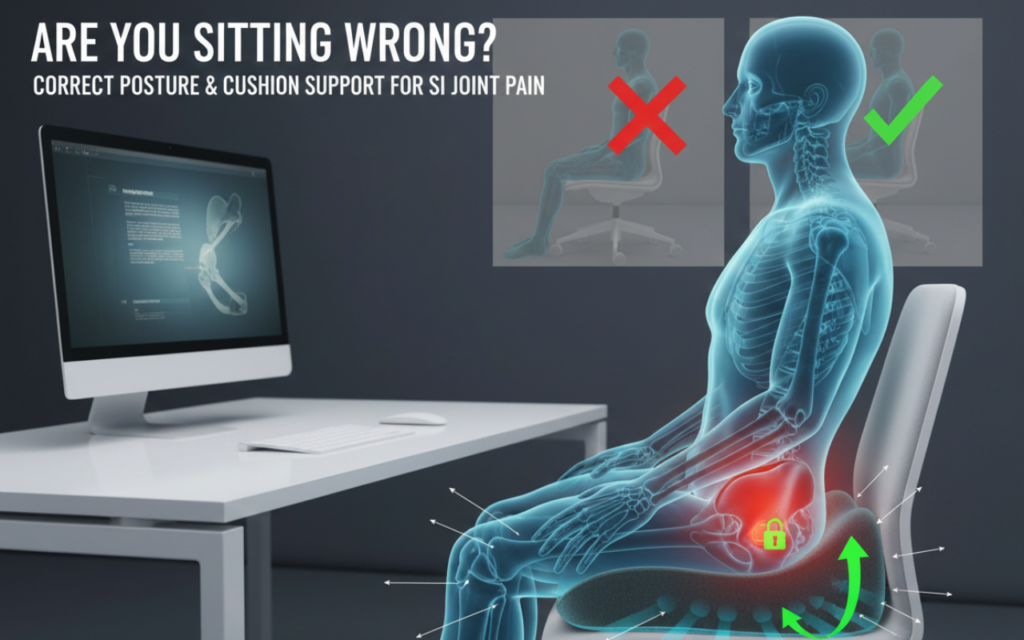
To sit with SI joint pain, keep both feet supported, your hips level with each other and at or slightly above knee height, your lower back supported by the backrest, and your weight spread evenly across both sit bones. These adjustments combine OSHA’s workstation guidance with the sitting tips Healthline lists for SI joint pain. Change one thing at a time so you can tell what helps.
| Body area | What to aim for |
|---|---|
| Feet | Flat on the floor or on a stable footrest, never dangling |
| Seat height | Thighs roughly parallel to the floor, with knees about level with or slightly below your hips. Avoid very low seats that fold your hips sharply. If your chair is too low, see how to raise your office chair height without replacing the gas lift |
| Seat depth | Deep enough to support your thighs, but the front edge should not press into the backs of your knees |
| Back support | Sit back into the backrest with your lower back supported. If your chair lacks lumbar support, a small pillow or cushion behind your lower back can help |
| Weight balance | Keep both sit bones in contact with the chair and the tops of your hips level with each other. Keep a bulky wallet out of your back pocket, since it can tilt you to one side |
| Legs | Uncrossed, with knees slightly apart |
| Upper body | Chest up and shoulders relaxed, with the top of your screen at or just below eye level so you are not leaning forward. For more on this, see our posture fixes |
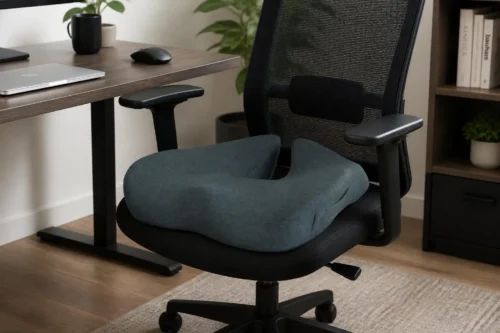
If your chair cannot be adjusted to fit, a footrest, a lumbar pillow, or a seat cushion that raises a low seat can close the gap. At work, you can also ask your employer for an ergonomic assessment.
Break Up Long Sitting With Movement
The most practical way to break up long sitting is to stand up and move about every 30 minutes; even a short walk helps. A Columbia University study of 11 adults found that 5 minutes of light walking every 30 minutes lowered both blood pressure and blood sugar compared with sitting all day. That study looked at general health, not SI joint pain, but it supports the same habit.
What Should a Movement Break Look Like?
A movement break can be very simple. Stand up, walk for one to five minutes, then sit back down and reset your position.
- Set a repeating timer so you don’t lose track of time.
- Use breaks for something you already do, such as refilling your water or stretching your legs on the way to the printer.
- When you stand, spread your weight evenly across both feet. Standing can irritate an SI joint too, especially if you rest most of your weight on one leg.
- If your job allows it, a sit-stand desk gives you another way to vary your position.
For a simple routine you can follow, see our 20-minute sit-stand-move rule.
Should I Stretch or Exercise for SI Joint Pain?
Ask a clinician before starting a new stretching routine, because the right exercises depend on the person. The American Family Physician review describes conservative treatment as a program of education, pelvic stabilization exercises with focused stretching, and manual therapy, delivered by a physical therapist or trained clinician. If your pain is sharp or one-sided, get it assessed before you stretch on your own.
Where a Seat Cushion Fits In
A seat cushion can make long sitting more comfortable, but it is a supporting tool, not a treatment for the SI joint. Research on cushions specifically for SI joint pain is limited, and no cushion can replace a diagnosis, posture changes, or regular movement.
Research on seating aids suggests forward-sloping designs may suit people who habitually sit slouched, while people with an exaggerated lower-back curve have reported more symptoms with aids that increase it. In other words, a tilted wedge is not automatically right for everyone.
What Can a Seat Cushion Realistically Do?
A well-made cushion can add padding, spread pressure across your thighs and buttocks, and raise a low seat, but it cannot correct your posture or treat the joint itself. In practice, that means it can:
- Add padding and spread pressure during long sitting.
- Lift you slightly if your chair is too low, so your hips are not sharply bent.
- Take pressure off the tailbone if you also have tailbone pain (a rear cutout does this).
What Should You Look For in a Seat Cushion?
Look for a cushion that is firm enough to hold its shape, wide enough to support both thighs evenly, and stable enough not to slide around on your chair. A foam that is too soft lets your pelvis sink or tip to one side, and a removable, washable cover keeps it fresh for daily use.
Introduce a new cushion gradually and stop using it if your pain gets worse. If you are pregnant, recovering from surgery, or have a diagnosed condition, check with your clinician first.
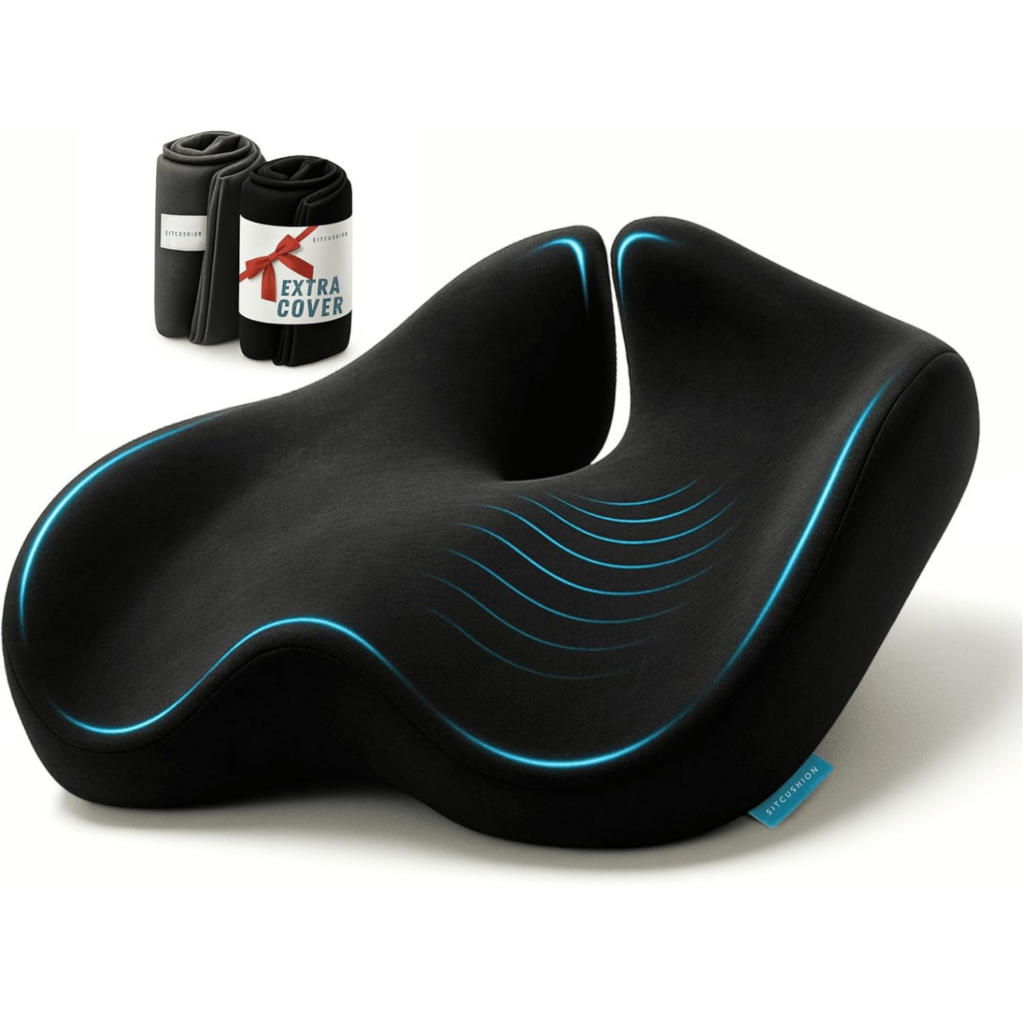
The Sitcushion Office Seat Cushion is one example of this type: charcoal-infused memory foam with a U-shaped coccyx cutout, an extra-large 17.5 × 20 in. contoured footprint, and a removable, washable cover with a carry handle. It is designed for sitting comfort and is not a medical device. To compare more options, see our guide to the best seat cushions for office workers with SI joint pain.
Looking for fast shipping and secure checkout?
You can purchase the Sitcushion Pressure Relief Seat Cushion directly from Amazon.
Trusted by millions • Easy returns • Fast delivery
Driving, Pregnancy and Postpartum
The same sitting principles apply in the car and during pregnancy, but each situation has a few extra points to consider.
Driving
Many car seats sit low, and Healthline lists very low seats that bend the hips sharply among the positions to avoid. Adjust your seat so your hips are level with or slightly above your knees, keep your back supported, and stop for short walking breaks on long drives. For more, see our tips for preventing back pain while driving long distances.
Pregnancy and After Birth
Pelvic girdle pain can occur during pregnancy and after childbirth, and it is worth raising with your midwife or doctor rather than pushing through it. Our guide to ergonomic sitting for pelvic girdle pain in pregnancy covers sitting adjustments in more detail. The American Family Physician review notes that pelvic belts may benefit some postpartum patients, so ask your clinician whether one is suitable for you.
What Else Can Help?
Most SI joint pain is first treated with a combination of education, exercises that stabilize the pelvis, and manual therapy from a trained clinician. The American Family Physician review describes this multimodal approach as the usual conservative treatment, delivered by a physical therapist or another clinician trained in manual therapy.
If those measures do not help, specialists may consider injections, radiofrequency ablation, or, in some cases, SI joint fusion. Posture changes and a supportive cushion are helpful extras, but they are not substitutes for a proper diagnosis.
When to See a Doctor
See a doctor if your SI joint pain does not improve after a few weeks, and get emergency help immediately if you notice numbness around your groin or inner thighs, new leg weakness, or loss of bladder or bowel control. Book an appointment if:
- The pain has not improved after a few weeks.
- The pain wakes you at night, or morning stiffness lasts more than 30 minutes and eases with movement, especially if it started before age 45. This pattern can point to inflammatory back pain that needs evaluation.
- The pain started after a fall, accident, or injury.
- You have a fever or feel generally unwell along with the back pain.
- You notice new numbness, tingling, or weakness in a leg.
Go to the emergency department immediately (in the US, call 911) if you have numbness or pins and needles between your inner thighs or genitals, numbness around your back passage, new difficulty urinating or controlling your bladder or bowels, or new weakness in your legs. These can be signs of cauda equina syndrome, a rare but serious emergency.
Frequently Asked Questions
How should I sit with SI joint pain?
Sit with both feet supported, your hips level with each other and at or slightly above knee height, your lower back supported by the backrest, and your weight even on both sit bones. Keep your legs uncrossed and stand up to move about every 30 minutes. The setup table above walks through each adjustment.
Why does SI joint pain hurt more when I sit?
Sitting can aggravate an irritated SI joint mainly through lopsided positions, long stretches without moving, and seats that are very low or so high that your legs dangle. Researchers do not fully understand the exact mechanism, so the practical fix is to sit evenly, support your lower back, and move often.
Why does it hurt when I stand up after sitting?
Pain when getting up from a chair is one of the most commonly reported patterns of SI joint pain, and the exact reason is not fully understood. To ease the transition, scoot to the front of the seat, plant both feet flat, stand up using your legs, and keep your weight even across both feet before you walk off. If the pain is severe or getting worse, have it assessed.
Is crossing my legs bad for SI joint pain?
It can be. Crossing your legs lifts one hip above the other, and clinical guidance for SI joint pain recommends keeping your hips level with each other. If you tend to cross the same leg, keep both feet flat on the floor or on a footrest instead.
How long can I sit with SI joint pain?
There is no universal limit, and tolerance varies from person to person. One spine clinician advises standing up at least every 30 minutes to walk for about a minute. If your pain builds sooner, take breaks sooner.
Is standing better than sitting for SI joint pain?
Neither is better for everyone, because standing can irritate the SI joint too, especially if you rest most of your weight on one leg. The most reliable approach is to alternate between sitting, standing, and walking, and to keep your weight even on both feet when you stand. A sit-stand desk can make this easier.
Does a seat cushion help SI joint pain?
A seat cushion may make long sitting more comfortable, but it does not treat the SI joint. Research on cushions specifically for SI joint pain is limited, and a forward-tilting wedge is not right for everyone. Use a cushion alongside posture changes and regular movement.
What is the best seat cushion for SI joint pain?
No single cushion is best for everyone. Look for one that is firm enough to hold its shape, wide enough to support both thighs evenly, and stable on your chair, and stop using it if your pain gets worse. For a detailed comparison, see our guide to the best seat cushions for office workers with SI joint pain.
Is a donut cushion good for SI joint pain?
Research on donut cushions specifically for SI joint pain is limited. They are mainly designed to relieve pressure on the tailbone and the area between your sit bones, so they usually suit tailbone or perineal pain better than pain at the SI joint. If your pain is in the low back or buttock, start with posture, movement, and a cushion that supports both thighs evenly. If your discomfort is mainly at the tailbone or between your sit bones, the Sitcushion donut cushion is designed to take pressure off that area.
How can I tell SI joint pain from sciatica?
The two overlap, so symptoms alone cannot reliably separate them. SI joint pain is usually felt in the low back and buttock, but a 2000 study found that 28% of people with confirmed SI joint pain also had pain below the knee. A clinician can use exam tests and, if needed, further testing to identify the source. Our guide to relieving sciatica pain covers the other side.
Can SI joint pain go away on its own?
Acute SI joint pain from a minor strain may settle within days to weeks, but pain that lasts or keeps coming back should be assessed. First-line care usually combines education, exercises that stabilize the pelvis, and sometimes manual therapy from a physical therapist.
Explore more practical guides in the Sitcushion Knowledge Center.
Sources
This guide draws on the following clinical, ergonomic, and health-system sources. Details about the Sitcushion Office Seat Cushion come from the product’s own listing.
- Newman DP, Soto AT. Sacroiliac Joint Dysfunction: Diagnosis and Treatment. American Family Physician, 2022.
- Slipman CW, et al. Sacroiliac Joint Pain Referral Zones. Archives of Physical Medicine and Rehabilitation, 2000.
- Occupational Safety and Health Administration (OSHA). Computer Workstations eTool.
- Healthline. How to Sit With SI Joint Pain.
- Diaz KM, et al. Breaking up prolonged sitting with light-intensity walking. Medicine & Science in Sports & Exercise, 2023 (Columbia University Irving Medical Center).
- Study of inclined wedge and block seating aids and spinal posture, PubMed Central (PMC6034358).
- Yale Medicine. Could Your Back Pain Be From Axial Spondyloarthritis?
- Torbay and South Devon NHS Foundation Trust. Cauda Equina Syndrome.
- Spine-health. Sitting and Sleeping Comfortably With SI Joint Pain (article and clinician video).
- Hinge Health. How to Sit With SI Joint Pain.
- St. Charles Health System. Sacroiliac Joint Pain.
- Mass General Brigham. SI Joint Pain.
Medical disclaimer: This article is for general information only and is not a substitute for professional medical advice, diagnosis, or treatment. Always seek the advice of a qualified healthcare provider about your symptoms. The Sitcushion Office Seat Cushion is not a medical device and is not intended to diagnose, treat, or prevent any condition.
Download This Article
How to Sit With SI Joint Pain: Posture, Chair Setup and Daily Habits
Save this guide as a PDF to keep the chair-setup checklist, movement tips, and warning signs to see a doctor handy whenever you sit down to work.