





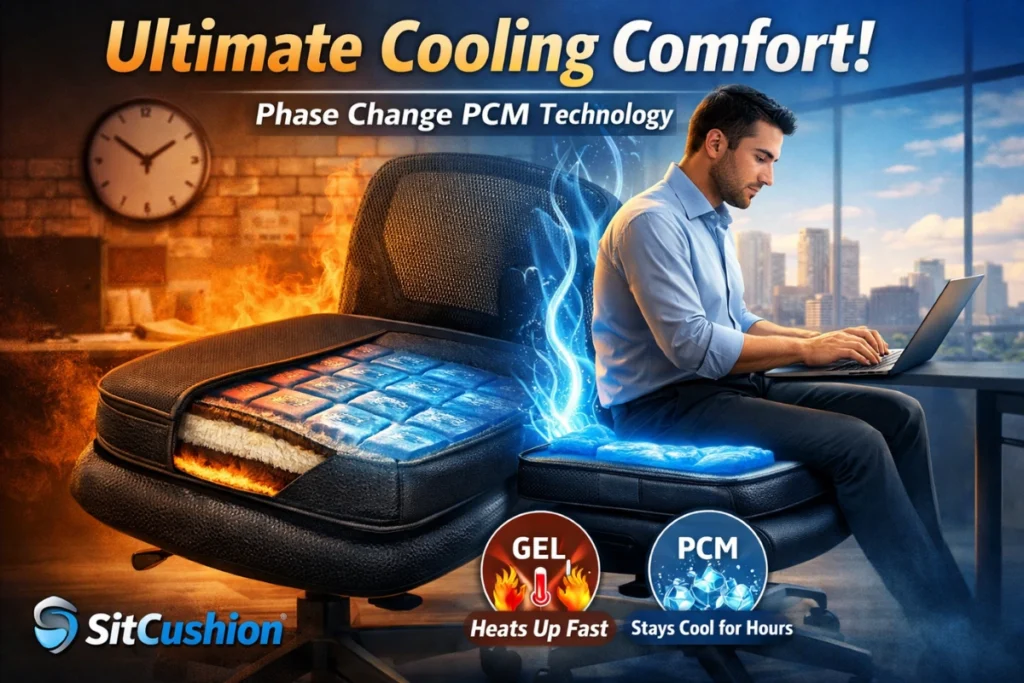
It’s mid-afternoon and you’re still in your chair, or still on the road. Your thighs feel damp, your lower back is sticking to the seat, and you can’t stop shifting. If that sounds familiar, your cushion may be part of the problem.
A standard memory foam cushion is a good insulator, so it holds body heat and moisture against your skin. Cooling seat cushions try to fix this with gel, phase change material (PCM), or breathable designs. They work in very different ways, and the claims on the box are often vague.
This guide explains how each type works, how long the cooling realistically lasts, and how to choose the right one for your chair, car, and climate.
Quick answer: Do cooling seat cushions work? Yes, within limits. PCM absorbs heat while it melts and can hold a steadier surface temperature for a limited time before it needs to recharge. Gel feels cool at first, then warms toward body temperature. Foam traps heat, and breathable designs mainly move air and moisture. The best choice depends on how long you sit and how hot the room is.
Why Does Your Seat Cushion Get So Hot?
Your seat cushion gets hot because sitting blocks the normal ways your body sheds heat. Skin pressed against a cushion can’t release warmth and moisture into the air the way exposed skin can, so the contact surface slowly turns warm and damp.
Memory foam makes this more noticeable. Its dense structure is a good insulator, which helps with cushioning but gives heat nowhere to go. A plush or tightly woven cover adds to the effect.
In clinical settings, the temperature and humidity at the point where skin meets a seat or mattress is called the microclimate. Nurses are taught to manage it because rising skin temperature and trapped moisture make skin more vulnerable. For office workers and drivers the issue is mostly comfort, not injury, but the principle is the same: less trapped heat and moisture means a more comfortable seat.
Key takeaway: A hot seat is usually a heat-and-moisture problem, not just a “soft cushion” problem, so the best fix is a material or design that moves heat away from your skin or absorbs it.
How Does a PCM (Phase Change Material) Cooling Cushion Work?
A phase change material (PCM) absorbs large amounts of heat while it melts, without getting hotter itself. In a seat cushion, that lets the PCM layer soak up your body heat and hold the surface at a fairly steady temperature for a while.
The science in plain language
Most materials heat up as they absorb energy. A PCM does this only until it reaches its melting point. From there, as MIT engineers explain, adding heat doesn’t raise its temperature until all the solid has turned to liquid. The energy is stored as latent heat instead. Manufacturers choose a PCM whose melting point suits skin contact, so as your body warms the cushion, the material starts to melt and keeps the surface from continuing to heat up.
What are the limits of PCM cushions?
- It runs out. Once all the PCM has melted, it warms up like any other material. How long that takes depends on how much PCM the cushion contains, how warm the room is, and how much heat you give off. Thin coatings or small amounts mixed into foam store very little heat, so there is no universal “number of hours.”
- It needs to recharge. To work again, the PCM must cool below its freezing point and re-solidify. In a cool room that can happen while you’re away from the seat. In a hot room or a parked car it may not. Always follow the manufacturer’s instructions for recharging.
- It isn’t a refrigerator. A PCM holds its temperature near its melting point. It can’t cool below it, and in a very hot environment it will melt faster.
Researchers have tested PCM in seating, for example PCM microcapsules added to polyurethane foam for wheelchair cushions, and report that improving thermal comfort is possible. Results depend heavily on the design, though, and independent head-to-head tests of retail PCM and gel cushions are scarce. Treat precise promises like “8 hours of cooling” with caution.
Key takeaway: PCM can hold a steadier, cooler surface than plain foam, but only for a limited time, and it works best when it can cool down and re-solidify between uses.
Does a Cooling Gel Seat Cushion Actually Stay Cool?
A gel cushion feels cool at first, but it gradually warms toward your body temperature. Unlike PCM, gel doesn’t melt at body temperature, so it has no built-in way to keep absorbing heat. How quickly it warms depends on its thickness and design.
Why does gel feel cold when you sit down?
Materials that conduct heat well feel cool to the touch because they pull warmth from your skin quickly. Gel generally conducts heat better than air-filled foam, so the first minutes feel noticeably cooler. That sensation fades as the gel approaches skin temperature.
Are all gel cushions the same?
No. The design makes a big difference:
- Gel-infused foam is regular foam with gel beads or swirls mixed in. The foam is still the main insulator, so the effect is modest.
- A gel layer on top of foam gives a stronger initial cool feeling, but it still sits on a heat-trapping base.
- A solid gel grid (honeycomb design) has open channels that let air and heat escape. It often handles long sitting in warm rooms better than the other gel types, but it tends to be firmer and heavier, with less contouring.
Key takeaway: “Gel” covers very different products. A gel grid works mainly through airflow, while gel-infused foam mostly offers a brief cool feel.
PCM vs Gel vs Foam vs Breathable Cushions: Which Cools Best?
| Cushion type | How it manages heat | Strengths | Limitations | Best for |
|---|---|---|---|---|
| Standard memory foam | Doesn’t; it insulates | Deep contouring, pressure relief | Traps heat and moisture | Air-conditioned rooms, shorter sits |
| Gel-infused foam | Gel conducts heat away at first | Slightly cooler initial feel | Foam underneath still insulates; effect fades | Moderate sits in mild climates |
| Gel grid (honeycomb) | Open channels allow airflow | Good passive airflow; no recharging | Firmer, heavier, less contouring | Long sits in warm rooms |
| PCM | Absorbs heat while melting at a near-constant temperature | Holds a steadier surface temperature for a limited time | Finite capacity; must re-solidify; amount of PCM varies | Sits with breaks and a cool place to recharge |
| Breathable or ventilated (mesh covers, spacer fabric, powered fans) | Moves air and moisture away | Reduces dampness; no recharging | Can’t cool below the air temperature; fans need power | Humid climates, cars |
Bottom line: No single type wins everywhere. Pick based on how long you sit, how hot the room is, and whether the cushion gets a chance to recharge or air out between sessions.
How Long Does a Cooling Seat Cushion Stay Cool?
There is no universal number. How long a cushion stays cool depends on its type, the room temperature, and how much heat your body gives off. Be cautious with any product that promises a fixed duration, such as “8 hours of cooling,” without explaining how it was measured.
Here is what shapes the answer for each type:
- PCM: Cooling lasts until the material has fully melted. That depends on how much PCM the cushion contains, how its melting point compares to the room temperature, and how long you sit without a break. In a room that is already warmer than the melting point, a PCM layer may have little left to absorb.
- Gel: The cool feeling is strongest in the first minutes and fades as the gel approaches skin temperature. Thicker gel layers and open gel grids tend to stay comfortable longer than thin pads.
- Memory foam: It offers no cooling effect, so it only gets warmer the longer you sit.
- Breathable or ventilated designs: They help for as long as air can move through them, so they don’t “run out,” but they can’t cool below the surrounding air temperature.
How can you make the cooling last longer?
- Stand up regularly. A few minutes off the seat every hour lets gel and PCM release the heat they absorbed.
- Keep the cushion out of direct sun before you sit, especially in a car.
- Start with a cool cushion if the product is designed to be chilled or recharged (see the next section).
What should you ask before buying?
For PCM cushions, look for the melting point, the amount or thickness of PCM, and the recharge instructions. If a brand can’t tell you these, treat the cooling claims with caution.
Key takeaway: Cooling duration depends on design and environment, so judge a cushion by how it works, not by a headline number.
How Do You Recharge a PCM Cooling Cushion?
To recharge a PCM cushion, let it cool below its melting point so it turns back into a solid. A PCM releases the heat it stored when its temperature drops below its freezing point, and only then can it absorb heat again.
How you do this depends on the product, so follow the manufacturer’s instructions first. In general:
- In a cool room, the PCM may re-solidify on its own while you’re away from the seat.
- In a warm room or car, it may not solidify at all, because the surroundings never get cold enough.
- Some products recommend chilling the insert in a refrigerator or a cool place. Avoid the freezer unless the instructions say it’s safe, since very low temperatures can make an insert stiff and uncomfortable to sit on.
Recharging time varies from product to product, so rely on the label rather than a generic number. Also check inserts for leaks or damage before reuse, and don’t wash or heat them in ways the manufacturer doesn’t allow.
Gel and breathable cushions don’t need recharging. They simply return toward room temperature once you stand up.
Key takeaway: A PCM cushion is only as reusable as your environment allows, so make sure you have somewhere cool to recharge it.
Does the Cushion Cover Matter for Cooling?
Yes. The cover is the layer touching your skin, so it strongly affects how hot the cushion feels. A thick, plush, or non-breathable cover can trap heat and moisture and cancel out much of what the cooling layer underneath is trying to do.
What to look for in a cooling cushion cover:
- A thin, breathable fabric such as mesh, a light knit, or spacer fabric. It lets heat reach the cooling layer and lets moisture escape.
- Moisture-wicking or quick-drying material, which helps when you sweat.
- A removable, washable cover for hygiene, since sweat builds up over time.
Be careful with waterproof or coated covers. They are easy to wipe clean, but they are typically less breathable, which can make the surface feel warmer.
Airflow beyond the cover matters too. Open gel grids, ventilated cushions, and powered fans all work by moving air. Your chair counts as well: a mesh chair lets heat escape, while leather or vinyl seats tend to hold it.
Key takeaway: A great cooling layer under a heavy cover is a wasted upgrade. Check the cover before you buy.
What Is the Best Cooling Cushion for Hot Climates, Cars, and Offices Without AC?
In hot environments, choose a design that doesn’t depend on recharging. An open gel grid or a ventilated, breathable cushion usually copes better with constant heat than a PCM cushion, which can stay melted when the surroundings never cool down enough.
What works best in a warm office without air conditioning?
- A gel grid or ventilated cushion with a breathable cover
- A PCM cushion only if you can recharge it in a cooler spot between sessions
- Regular breaks, so any cooling layer can release heat
What works best in a car?
A parked car can get far hotter than a room, so a cushion left on the seat starts hot. Parking in the shade or using a sunshade helps, and so does removing the cushion from direct sun. Leather and vinyl seats hold heat, so a breathable cushion with airflow often feels better on long drives than a plain foam one. Some powered ventilated cushions run from the car’s power outlet. These can help, but they add cables and depend on that power.
Can a cushion fix overheating?
No. A cushion improves comfort at the seat, but it can’t fix overheating of your whole body. Stay hydrated and take breaks in the shade or in cooler air when it’s very hot.
Key takeaway: The hotter and less controlled the environment, the more you should favor airflow-based designs over ones that need recharging.
Who Should Be Extra Careful When Choosing a Cooling Cushion?
If you have sensitive skin, reduced sensation, or limited mobility, talk to a healthcare professional before relying on a cooling cushion. Most people can pick a cushion by comfort alone, but a few situations call for more care:
- Reduced sensation. If you can’t feel temperature or pressure well, you may not notice a surface that is too cold, too hot, or pressing too hard.
- Long periods without moving, such as extended wheelchair use or limited mobility. In these cases the cushion’s main job is pressure redistribution and fit, and cooling is a secondary feature. A seating specialist, occupational therapist, or doctor can recommend the right cushion for you.
- Sensitive or broken skin. Avoid cold inserts against bare skin for long periods, and check your skin regularly.
A cooling cushion is a comfort product, not a treatment, and it doesn’t replace changing position, regular movement, or professional advice. Sitcushion products are designed for ergonomic comfort and are not medical devices.
How Do You Choose a Cooling Seat Cushion? 8 Things to Check
Choose by how the cushion manages heat, not by the word “cooling” on the box. Check these before you buy:
- The cooling method. Is it PCM, gel-infused foam, a gel grid, a breathable or ventilated design, or a powered fan? Each behaves differently (see the comparison above).
- PCM details. If it uses PCM, look for the melting point, the amount of PCM, and the recharge instructions.
- The cover. A thin, breathable, removable, washable cover works better than a thick, plush, or coated one.
- Support first. Cooling shouldn’t cost you the support you bought the cushion for. Make sure it is firm enough for your weight and fits your chair.
- Your environment. An air-conditioned office, a hot room without AC, and a parked car each favor a different design.
- Weight and grip. Gel grids can be heavy, and a non-slip base matters on smooth chairs and leather car seats.
- Red-flag claims. Be cautious about “stays cold all day,” “scientifically proven” with no data, and “active cooling” for products with no power source.
- Care and durability. Check the care instructions, the warranty, and how well the materials hold up. Our guide to assessing seat cushion durability covers this in detail.
Frequently Asked Questions About Cooling Seat Cushions
Do cooling seat cushions really work?
Yes, to a degree. A good cooling cushion reduces heat and moisture build-up compared with plain memory foam, but it won’t make a hot seat feel cold. PCM absorbs heat while it melts, gel feels cool at first, and breathable designs move air and moisture. How well each works depends on the design and your environment.
Are cooling seat cushions worth it?
They’re worth it if heat is your main complaint and you sit for long stretches. If you work in an air-conditioned room or sit for short periods, a regular cushion with a breathable cover may be enough.
Why does my gel seat cushion get hot after a while?
Gel has no built-in way to keep absorbing heat, so it warms toward your body temperature as you sit. Gel-infused foam also sits on foam that insulates. To help, stand up regularly, keep the cushion out of the sun, use a thin breathable cover, or choose an open gel grid, which lets air move through.
How long does a cooling seat cushion stay cool?
It depends on the type, the room temperature, and your body heat, so there is no fixed number. Gel is coolest in the first minutes. PCM cools until it has fully melted. Breathable designs help for as long as air can move through them. Be wary of any cushion that promises a set number of hours without explaining how it was measured.
What’s the difference between a PCM and a gel cooling cushion?
PCM absorbs heat while it melts at a near-constant temperature, while gel mainly conducts heat away and then warms up. PCM can hold a steadier surface temperature for a limited time but must re-solidify before it works again. Gel needs no recharging but its cooling effect fades as it reaches skin temperature.
Do memory foam seat cushions make you hot?
Yes, standard memory foam tends to trap heat. Its dense structure insulates, so heat and moisture build up between you and the seat, especially with a plush cover. Gel infusions, open-cell foam, and breathable covers can reduce this, but they don’t remove it completely.
What is the best cooling seat cushion for hot weather or an office without AC?
An open gel grid or a ventilated cushion with a breathable cover usually copes best. These designs work through airflow and don’t depend on recharging. PCM works better when you can cool it down between uses.
Can you put a seat cushion in the freezer or fridge?
Only if the manufacturer says it’s safe. Most cushions aren’t designed to be frozen, and cold can damage foam or covers and make the surface uncomfortably hard. PCM inserts made for chilling come with their own instructions, so follow those.
Do cooling seat cushions work in a car?
They can help, but a hot car is a tough environment. A cushion left in the sun starts hot, and PCM or gel can’t cool down inside a hot cabin. Park in the shade or use a sunshade, and choose a breathable or ventilated cushion. Powered ventilated cushions can also help, but they depend on the car’s power outlet.
How do I stop sweating on an office chair all day?
Reduce what traps heat and moisture. Use a breathable cushion cover or a ventilated or gel-grid cushion, wear lighter fabrics, take short standing breaks, and use a mesh chair or a desk fan if you can. If you sweat heavily regardless of temperature, speak with a doctor.
Are cooling cushions suitable for wheelchair users?
They can be a useful feature, but fit and pressure redistribution come first. Heat and moisture at the skin-to-seat contact point, known as microclimate, are among the factors clinicians consider. A seating specialist or therapist can help you choose a cushion that suits your body and needs.
Conclusion: Choose by Environment, Not by Buzzword
Cooling seat cushions don’t work the same way, and none of them is perfect for every situation. PCM can hold a steadier temperature for a limited time, gel gives a quick cool feel that fades, and breathable or ventilated designs keep working by moving air. The best choice depends on how long you sit, how hot your space is, and whether the cushion can recharge or air out between sessions.
If you’re still deciding whether a cushion is right for you, read our guide on whether a seat cushion really helps, or explore more in our Knowledge Center.
How We Researched This Guide
This guide is based on published engineering and clinical sources rather than our own lab testing. We have not tested individual products for this article, and we don’t claim exact cooling durations because independent head-to-head data on retail cushions is limited. We’ll update this guide as better evidence becomes available.
Free PDF Guide
Cooling Seat Cushions: PCM vs Gel vs Foam, Which Works Best
Download our free guide to cooling seat cushions and learn the key differences between PCM, gel, and foam, how each material works, and which option may be the best fit for your needs.