Skip to content
Part I: The Durability Crisis – Why Your Cushion Flattened Fast
1.0. Introduction: Transforming Your Purchase from Expense to Investment
Seat cushion durability is the most critical factor separating a temporary comfort solution from a true long-term investment in ergonomic health. The modern ergonomic seat cushion has become an essential tool for millions of individuals who spend prolonged hours sitting, whether in an office, a vehicle, or a home setting. Cushions are fundamentally designed to maintain posture, provide comfort, and distribute pressure evenly, thereby addressing chronic issues such as lower back pain, tight hips, and coccyx soreness.
Struggling with lower back or coccyx pain from a flattening cushion?
However, consumers frequently encounter a major point of disappointment: the rapid functional failure of the cushion, often purchased with the expectation of pain relief, when it sags, flattens, or loses its supportive structure within months. This pervasive issue necessitates a deeper understanding of true seat cushion durability. Durability extends beyond the cover’s resilience; it is defined by the core material’s sustained ability to maintain its original, supportive shape and its viscoelastic properties under constant, repetitive heavy load over several years. A cushion that fails to provide consistent support transitions from an ergonomic tool to a functional liability.
This analysis introduces the “7 Expert Factors”—a definitive checklist derived from material science and manufacturing standards—that allows consumers to move past habitual, frequent replacement and confidently identify quality construction. By understanding these factors, the purchasing decision transforms from a recurrent expenditure into Guaranteeing a Long-Term Investment in sustained health and comfort, founded on high seat cushion durability.
1.1. The Anatomy of Failure: Why cheap cushions flatten fast (and what to look for in a quality core)
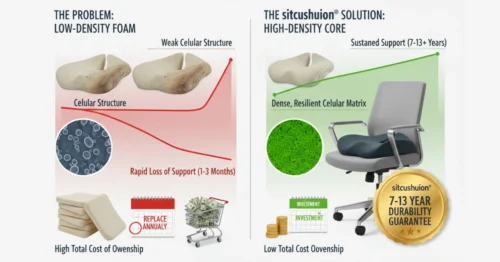
The primary reason many users find their cushions fail prematurely lies in the material composition of the core. When comparing high density foam vs low density, it becomes clear that low-cost products prioritize low initial manufacturing expenditure over long-term structural integrity. These budget cushions often utilize low-density or unstructured foam, typically rated between 1.5 to 1.7 pounds per cubic foot (lbs/ft³). This low-grade foam is inherently unsuitable for resisting the intense, repetitive compression associated with all-day seating.
The mechanism of mechanical breakdown is simple but crucial to understand. Density is a measurement that tells you how much material is packed into a specific volume. Low density translates to fewer structural connections within the foam’s cellular matrix. Under constant use, this weaker matrix cannot rebound effectively, causing it to soften rapidly and develop permanent depressions, or sagging. The perception of softness or plushness at the time of purchase is often a predictor of rapid structural failure in these cases, resulting in poor seat cushion durability.
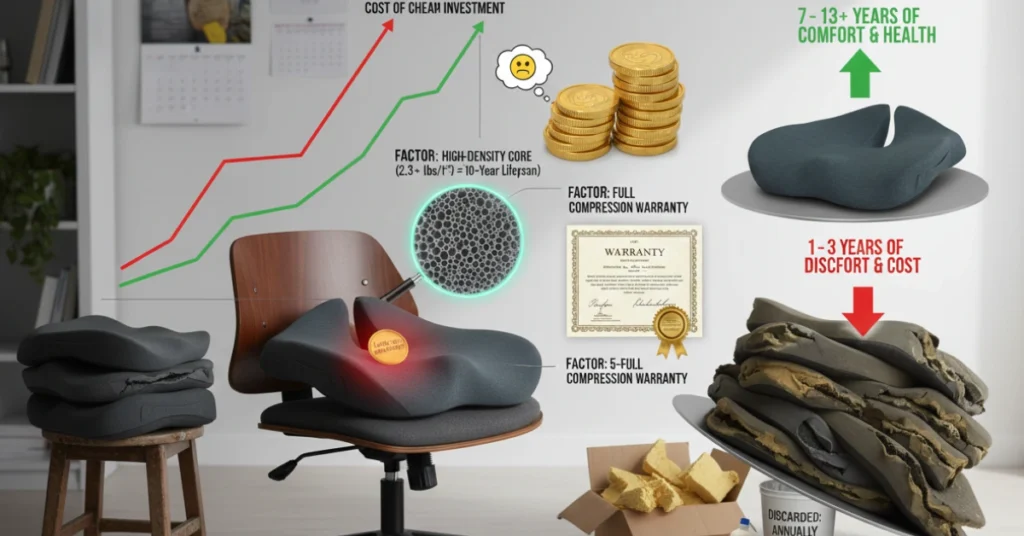
The consequence of this failure is the hidden cost of purchasing cheap products. While the initial price is low, the expenditure on low-quality foam is quickly negated by the need for frequent replacement, leading to a much higher total cost of ownership (TCO) over a five-to-ten-year period. Furthermore, the intermittent discomfort and potential exacerbation of orthopedic issues resulting from inconsistent support introduce health costs that far outweigh the initial savings. The only way to mitigate this financial and physical loss is to prioritize quality materials engineered for exceptional seat cushion durability.
1.2. Warning Signals: How to spot the warning signs that your ergonomic cushion is losing support
For high-use items, knowing How to spot the warning signs that your ergonomic cushion is losing support is paramount to avoiding functional failure and protecting health. The initial indicators of cushion degradation include visible signs of wear and tear, such as sagging, ripples in the fabric, or failing seams.
However, the most critical failure point is the phenomenon known as “bottoming out.” This occurs when the cushion has lost its ability to rebound and distribute pressure evenly, allowing the user to feel the hard surface of the chair base through the foam. This sensation often manifests as intense pressure on the ischial tuberosities (the “sit bones”). When the foam core fails to rebound, it no longer diffuses the user’s weight across the seating surface.
Feeling sharp tailbone or sciatica pressure when your cushion bottoms out?
Once a cushion begins to bottom out, the support system has collapsed, and the product becomes functionally counter-ergonomic. The concentrated pressure points impede blood flow and directly contribute to the lower back and tailbone pain the user sought to eliminate. Therefore, identifying signs seat cushion is collapsing is not just about noting discomfort; it is a signal that the product has ceased being an accessory and has begun actively introducing health risks, necessitating immediate replacement. A durable cushion, like the premium line from sitcushion, is designed to prevent this collapse.
Part II: The 7 Expert Factors for Longevity and Performance
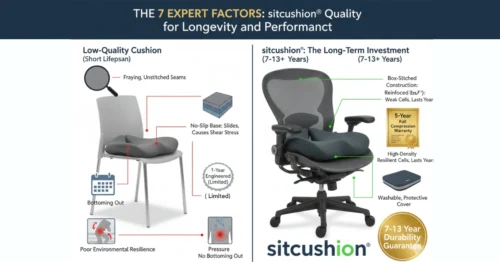
2.0. The Indispensable Checklist: Defining Investment-Grade Cushion Quality
Defining an investment-grade cushion requires moving beyond comfort to analyze the material science, construction methodology, and accompanying warranty provisions. The following seven factors provide a framework for objectively evaluating a product’s likelihood of achieving multi-year seat cushion durability and longevity.
2.1. Factor 1: The Core Science – Memory Foam Density (The Durability Index)
Density is the foundational determinant of durability in seat cushion materials, often referred to in the furniture industry as “comfort life”. This metric, measured in pounds per cubic foot (lbs/ft³), defines the amount of core material packed into the volume, independent of its initial softness or firmness.
The superior support and durability associated with high-quality ergonomic products stem directly from utilizing high-density foam (e.g., 2.3–2.5+ lbs/ft³). The dense internal structure is fundamentally resistant to the cellular compression and breakdown that plagues lower-quality foam. High-density materials can consistently maintain their support profile for 7 to 13 years or more, making them suitable for all-day and high-traffic applications.
2.1.1. Density vs. Firmness: Clarifying the Long-Term Durability Equation
It is essential to clarify that density is not synonymous with firmness. High density foam vs low density contrasts structural strength (durability) rather than initial feel (firmness). Firmness is measured by IFD (Indentation Force Deflection). A high-density cushion can be manufactured with a calibrated IFD to feel soft and conforming while maintaining the structural mass required for years of consistent use. The key to long-term seat cushion durability is the density rating. Consumers must establish a minimum density benchmark, such as 2.3 lbs/ft³, to ensure the product qualifies as investment-grade and avoids the cycle of rapid replacement.
Table 1: Density Thresholds and Anticipated Cushion Lifespan (lbs/ft³)
| Foam Density (lbs/ft³) | Recommended Usage | Estimated Lifespan | Consumer Impact |
| 1.5 – 1.7 (Low) | Occasional / Light Use | 1–3 years | Flattens quickly; suitable for budget or infrequent seating. |
| 1.8 – 2.0 (Moderate) | Everyday Use (Moderate Hours) | 3–7 years | Good comfort/support for everyday office use; requires eventual replacement. |
| 2.3 – 2.5+ (High) | All-Day, High-Traffic Use | 7–13+ years | Maximum durability, resists sagging; justifies long-term investment. |
Not sure which high-density cushion is actually worth the investment?
Best Seat Cushions for Pain Relief and Comfort – 2025 Buyer’s Guide
2.2. Factor 2: Material Resilience – Does a high-density memory foam cushion really last two years or more?
A critical component of memory foam cushion longevity is material resilience—the foam’s ability to recover its original shape quickly after pressure is released. High-density memory foam is expected to maintain its shape for several years, even in demanding environments like senior living facilities, due to its inherent resistance to losing form.
The question, “Does a high-density memory foam cushion really last two years or more?”, is definitively answered by this property. Quality memory foam’s capacity for rapid rebound directly extends the life of the cushion because it prevents permanent indentations from forming. Low-quality foam, by contrast, suffers from poor resilience, leading to permanent body impressions that accelerate functional failure. The resilience of the core directly impacts seat cushion durability.
Transform Your Office Comfort
Sit longer, focus better, and relieve pressure with the SitCushion Office Seat Cushion —
engineered to support your posture and reduce fatigue during long hours at your desk.
2.3. Factor 3: Structural Integrity – The benefits of box-stitched construction for preventing cushion collapse
The external construction of the cushion cover plays a vital role in maintaining the integrity of the foam core. Assessing box stitched construction durability is essential, as the cover acts as an exoskeleton, preventing the foam from bulging or shifting laterally.
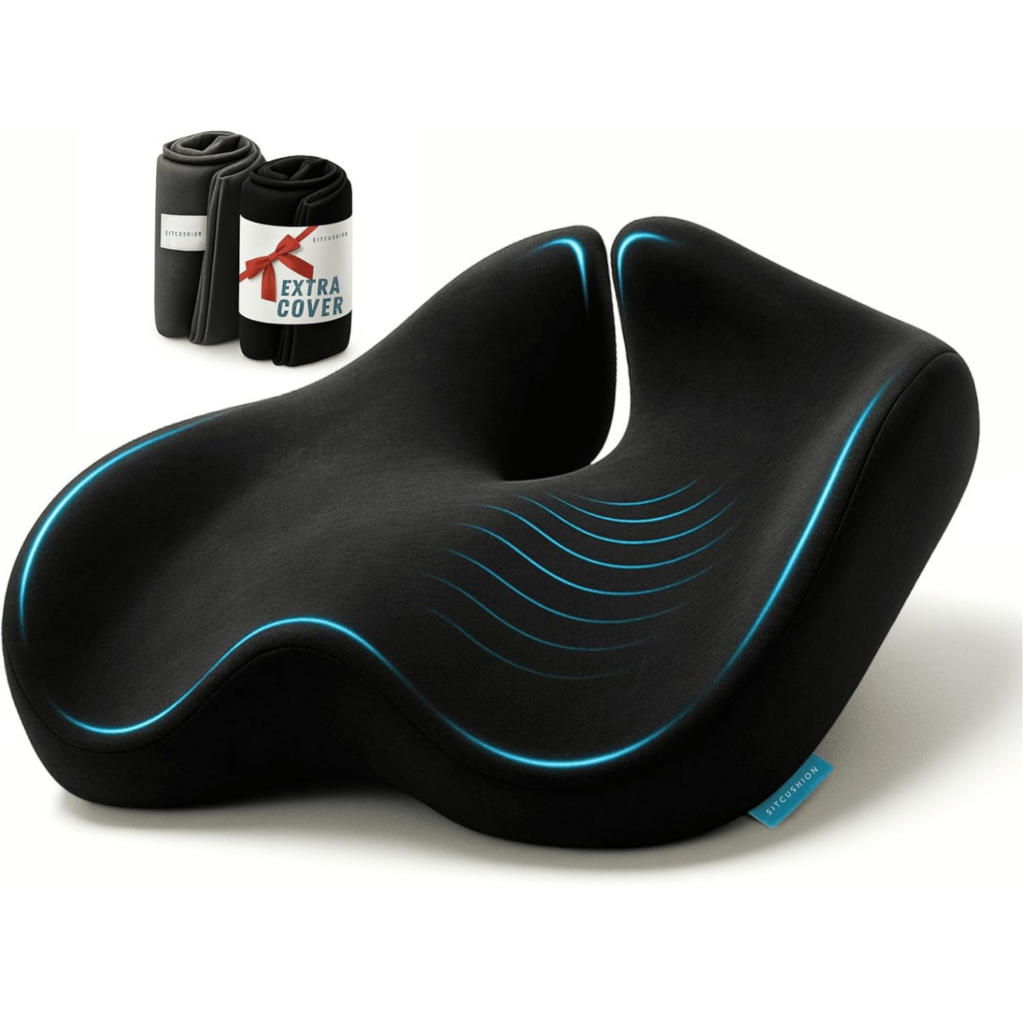
The box seam, or box-edge construction, is characterized by a separate side panel (a boxing strip) sewn between the top and bottom fabric pieces. This construction creates clean, straight, 90-degree edges. The resulting structure provides significant benefits for preventing cushion collapse: it stabilizes the foam squab and helps maintain its precise, engineered shape over time. This structural reinforcement is particularly critical for ergonomic cushions, which feature specialized shapes, such as coccyx cutouts, making it a critical factor in overall seat cushion durability.
When evaluating The benefits of box-stitched construction for preventing cushion collapse, it is clear that this technique elevates the cover from a mere aesthetic detail to a core durability factor. The tailored, reinforced edge of the box stitch ensures the cushion retains its engineered support geometry, maximizing the functional lifespan of the investment. sitcushion uses this construction methodology to ensure the integrity of the high-density core.
Need a cushion engineered for stable posture alignment and all-day support?
2.4. Factor 4: Non-Slip Engineering – What makes a seat cushion non-slip bottom essential for longevity?
A frequently overlooked factor in durability is stability. What makes a seat cushion non-slip bottom essential for longevity? The primary answer lies in mitigating shear stress—the lateral movement between the cushion and the chair surface caused by minor fidgeting, shifting, or standing. Cushions that slide, particularly those relying solely on tie-ons, compress faster and wear out prematurely because the foam is continually being twisted and stretched horizontally.
2.4.1. The Role of Anti-Slip Materials in Maximizing Support
High-quality non-slip materials provide the necessary friction to lock the cushion securely in place. Common and effective anti-slip technologies include:
-
Rubberized Coatings: Thin layers that offer great grip on most chair surfaces.
-
Silicone Dot or Grid Patterns: Raised shapes that enhance grip and breathability.
-
Textured Fabrics: Materials that use natural texture to resist sliding.
This stabilization ensures that when a user sits down or shifts position, the foam only compresses and rebounds vertically, as it was designed to. By eliminating lateral stress, the non-slip base drastically extends the physical lifespan of the memory foam core. Furthermore, a sliding cushion negates its own benefits; if the coccyx cutout moves out of alignment, the user must constantly adjust posture, undermining the orthopedic purpose of the cushion. The ultimate measure of seat cushion durability is its ability to remain stable and functional.
2.5. Factor 5: Warranty Decoding – Is a 1-year warranty standard for a durable seat cushion?
When purchasing a premium seat cushion, the warranty serves as the manufacturer’s declaration of confidence in the product’s lifespan. The question, “Is a 1-year warranty standard for a durable seat cushion?”, reveals the low bar set by the budget sector. While 1–3 years is common for electronics or high-wear components, commercial-grade seating often carries a warranty of 5–10 years. A high-density foam cushion sold with only a one-year warranty should raise suspicion regarding the core material’s true quality and its expected seat cushion durability.
Consumers are often attracted to claims like “Limited Lifetime” or promises of 10-year durability, prompting the question, “Should I pay more for a cushion that promises 10-year durability?” The analysis shows that these guarantees frequently apply only to non-wear components, such as the steel frame of a chair, while the critical wear components—the foam and fabric—are explicitly excluded or only covered for a limited period of 1 to 5 years. The only reliable metric is a warranty that specifically covers the permanent loss of shape or compression of the foam core for a minimum of five years.
Furthermore, many warranties do not cover the costs of labor or shipping required for replacement parts. This can add unexpected expenses to an otherwise valid warranty claim. Consumers should look for comprehensive coverage that minimizes or eliminates these potential hidden costs, protecting their Maximizing the lifespan of your memory foam seat cushion investment.
Table 2: Key Warranty Components for Ergonomic Seat Cushions
| Component | Typical Coverage Term | Critical Fine Print | Impact on Investment |
| Foam/Padding Core | 1–5 Years | May be explicitly excluded from “Lifetime” structure coverage. | Most critical factor for longevity; look for 5+ years for high-density foam. |
| Structural Frame/Base | 5 Years to Lifetime | Applies only to the hard structure, not compression of the foam. | Indicates manufacturer confidence in the core design and non-wear parts. |
| Labor and Shipping | Usually Excluded | Customer often bears the cost of transport for replacements. | Increases the effective cost of a warranty claim. |
2.6. Factor 6: Environmental and Usage Specifications
The cushion’s environment and care requirements dramatically affect its lifespan. Durability expectations must be matched to the intended use. Memory foam is particularly vulnerable to environmental factors, especially moisture and temperature fluctuations. Trapped dampness, whether from spills or high humidity, directly compromises the material structure, leading to breakdown and potential mold growth.
Another threat is UV degradation. While briefly airing foam in the sun can help with deodorizing, prolonged sun exposure must be limited. Extended ultraviolet radiation causes the foam structure to become brittle and degrade, reducing its memory foam cushion longevity.
Since the foam core is susceptible to moisture and solvents, the quality of the cushion’s cover is a critical durability shield. High-quality cushions, such as those made by sitcushion, feature covers that can be easily removed and washed. This feature prevents users from attempting to clean the sensitive foam core directly with liquids and harsh detergents, which is the fastest way to compromise the foam’s integrity.
2.7. Factor 7: Proactive Maintenance and Care Protocols – How to clean and maintain your seat cushion for maximum lifespan
Even the most robust, high-density foam can fail prematurely without proper care, confirming that seat cushion durability is a partnership between the manufacturer’s quality and the user’s diligence. How to clean and maintain your seat cushion for maximum lifespan is governed by a strict set of protocols.
The golden rule for minor spills is Blot, Don’t Rub. Immediate blotting with a clean, dry cloth absorbs liquid before it can migrate deep into the foam cells. When cleaning is required, only mild, gentle detergents should be used; harsh chemicals or bleach must be strictly avoided as they chemically degrade the foam structure.
The single most crucial step is Drying Discipline. Any foam that becomes damp must be allowed to air dry completely before being re-covered or used. Trapped moisture is the quickest way to compromise integrity and invite microbial growth. For deep cleaning and deodorizing, non-liquid methods are preferred. Regular vacuuming with an upholstery attachment removes dust and allergens. To absorb odors naturally, sprinkling a light layer of baking soda over the surface and allowing it to sit overnight before thorough vacuuming is recommended. Proper, proactive maintenance is the only way for the consumer to fully realize the 7-10+ year lifespan they purchased, cementing the value proposition of Maximizing the lifespan of your memory foam seat cushion investment. The importance of seat cushion durability cannot be overstated.
Want to keep your cushion fresh and extend its lifespan?
Part III: The Lifespan Equation and Final Transactional Guidance
3.1. Replacement Cycles: How often replace seat cushion and why?
Determining how often replace seat cushion is necessary relies on the formula: Lifespan = Density / Usage Intensity. For cushions made with cheap, low-density foam (1.5–1.7 lbs/ft³), replacement is typically required within 1–3 years. Conversely, cushions constructed with high-density, high-resilience memory foam (2.3+ lbs/ft³) should maintain their function for 7–10 years or more.
The ultimate replacement trigger, however, remains functional failure. Users must replace their cushion immediately upon experiencing bottoming out or persistent, localized discomfort. At this point, the cushion has functionally failed its ergonomic purpose and is actively causing harm, regardless of its age. Consistent support is non-negotiable for sustained ergonomic health.
3.2. The Investment Justification: Why Quality Pays for Itself (The sitcushion Advantage)
The evaluation of the 7 Expert Factors provides a clear, quantitative basis for identifying The most durable memory foam seat cushions for all-day office use. These cushions—characterized by high-density cores, structural stitching, non-slip stability, and robust warranties—represent sound financial investments.
While the premium initial cost may be higher, this expenditure amortizes rapidly when considering the total cost of ownership. Buying a durable, warranted product once, which reliably maintains support for a decade, is far more economical than perpetually replacing cheaper alternatives every 12 to 18 months. The investment ensures consistent, pain-free ergonomic support, eliminating both replacement costs and the severe health risk associated with using a collapsing cushion. Only products engineered to guarantee true seat cushion durability, such as the premium line offered by sitcushion, deliver this peace of mind.
3.3. Conclusion: Choose Durability, Choose sitcushion
Intelligent purchasing of ergonomic equipment relies on understanding core material science and comprehensive construction quality. True seat cushion durability is guaranteed not by price, but by verifiable structural components: the minimum high-density threshold of the foam core, the stabilizing benefits of box-stitched construction, and the protective reinforcement provided by a non-slip base.
The most valuable seat cushions are those where the manufacturer demonstrates confidence by offering a minimum 5-year warranty specifically covering core compression. Consumers seeking a reliable, long-term solution that meets all these criteria—transforming their purchase from a simple expenditure into a fundamental component of their daily ergonomic health—should prioritize products that adhere to these 7 Expert Factors. If you are ready to stop replacing cheap foam every year and invest in your health, explore our comprehensive ergonomic resources at our Knowledge Center or view our complete range of durable seat cushion products.
Part IV: Frequently Asked Questions (FAQ)
Q1: What is the main indicator that my seat cushion needs replacing?
The most critical sign is the phenomenon known as “bottoming out,” which means you can feel the hard chair surface beneath you. This occurs when the foam core has permanently compressed and can no longer provide even pressure distribution. Once this happens, the cushion ceases to be an ergonomic tool and starts introducing harmful concentrated pressure points, necessitating immediate replacement.
Q2: Does a higher price guarantee better seat cushion durability?
Not necessarily. Price should be viewed in correlation with material specifications. A truly durable, high-quality cushion must feature high-density foam (2.3+ lbs/ft³) and a comprehensive warranty of at least five years that specifically covers permanent foam compression. If a cushion is expensive but uses low-density foam (1.7 lbs/ft³ or less) and offers only a 1-year warranty, it is an over-priced expenditure, not a long-term investment.
Q3: How long should I expect a high-quality, high-density memory foam cushion to last?
A premium cushion constructed with high-density, high-resilience memory foam (2.3 lbs/ft³ and above) should reliably maintain its supportive shape and viscoelastic properties for 7 to 13 years or more, provided it is properly maintained. This far surpasses the typical 1–3 year lifespan of low-density, budget-focused cushions.
Q4: How does a non-slip bottom affect the lifespan of my cushion?
A non-slip bottom is essential for longevity because it prevents the cushion from shifting and sliding laterally. This micro-movement introduces “shear stress” that constantly strains the cover, weakens the seams, and accelerates the breakdown of the foam’s internal cellular structure. By stabilizing the cushion, a non-slip base ensures the foam only compresses and rebounds vertically, drastically extending the cushion’s lifespan.
Q5: How should I clean my memory foam cushion to maximize its lifespan?
The primary rule is to keep the foam core dry, as moisture is its greatest enemy. Use removable, washable covers for routine cleaning. For the foam core itself, only spot-clean minor spills by blotting, not rubbing, using a very mild detergent solution on a damp (not wet) cloth. Crucially, always allow the foam to air dry completely before replacing the cover or using the cushion again. You can use baking soda and vacuuming for deodorizing.
📩 Download This Article
How to Assess Seat Cushion Durability – 7 Expert Factors for Guaranteeing a Long-Term Investment