







If you sit more than 6 hours a day, your lower back, hips, and tailbone take the load first. The most common signs are lower back stiffness, tailbone pressure, and numbness in the legs by mid-afternoon. The good news is that most of it can be eased with small changes, in a simple order. Start with how you sit, then how often you move, and only then add support such as a seat cushion.
This guide shows you what long sitting does to your body, how to run a quick seating comfort test for long hours of work, and which fixes matter most. If you are comparing support options, our guide on lumbar support pillow vs seat cushion explains how the two work together. For a break schedule, see the 20-minute sit-stand-move rule. And if you already know you need a cushion, jump to our office chair seat cushion buying guide.
Is Sitting More Than 6 Hours a Day Bad for You?

Sitting more than 6 hours a day is linked to a higher risk of lower back discomfort and several long-term health problems, but the risk depends heavily on how much you move in between. Long, unbroken sitting is the real problem, not the chair itself.
Back and tailbone. A systematic review of studies that measured sitting time objectively found that prolonged sitting is linked to an immediate increase in low back pain. The same review notes it cannot yet prove that sitting alone causes long-term back pain episodes. In practice, that means how you sit and how often you break it up matter as much as the total hours.
Long-term health. A large meta-analysis in Annals of Internal Medicine found that adults with the most sedentary time had about a 24% higher risk of death from any cause and about a 91% higher risk of type 2 diabetes than those who sat the least. It also found that more physical activity reduced these risks, but did not erase them entirely. These are associations from observational studies, so they show risk, not certainty.
Is there a safe number of hours? Not exactly. The WHO 2020 guidelines tell adults to limit sedentary time and replace it with movement of any intensity, and the researchers behind them said the evidence was not strong enough to set a specific time limit. So “6 hours” is a useful warning sign, not a magic line. The goal is simple: sit less in one stretch, move more often, and make the hours you do sit more comfortable.
How to Test Your Seating Comfort for Long Hours of Work
The easiest way to test your seating comfort for long hours of work is to sit the way you normally do and check in at three points, after 30 minutes, after 2 hours, and near the 6-hour mark. Note where you first feel discomfort, then use the table below to find the most likely cause and the first thing to try.
Before you start, check the basics from OSHA’s workstation guidelines: feet flat on the floor (or on a footrest), thighs roughly parallel to the floor, your back supported by the backrest, and the front edge of the seat not pressing behind your knees.
| Where you feel it | What it usually points to | First thing to try |
|---|---|---|
| Lower back ache or sliding forward in the chair | The backrest is not supporting your lower back, or the seat is too deep | Sit all the way back and adjust the backrest. If it still does not fit, add a lumbar support (see lumbar pillow vs seat cushion) |
| Tailbone soreness or pressure | Too much weight resting on the tailbone from a flat or hard seat | Shift your weight forward slightly and check how much padding you have. A seat with a tailbone cutout can help, see our coccyx cushion guide |
| Hip or sit bone pain | Pressure is concentrated on a small area of a firm seat | Change position more often and try a pressure-distributing seat cushion |
| Tingling or numb legs, pressure behind the knees | The seat is too long, or the front edge presses on your legs | Leave about two to three fingers of space between the seat edge and the back of your knees, or move the backrest forward |
| Dangling feet or knees higher than hips | The chair height does not match your desk | Adjust the chair height or add a footrest |
| Neck and shoulder tension | The monitor or armrests are set wrong | See our proper sitting position guide |
| Stiff all over when you stand up | Too long without a break | Change position more often, see the sit-stand-move rule |
If discomfort keeps coming back after these adjustments, that is the point where a seat cushion is worth considering, because it fixes a problem the chair itself cannot. If you have severe pain, numbness that spreads down a leg, or pain that does not go away, talk to a doctor rather than relying on a cushion.
Start With Free Fixes Before You Buy Anything
The cheapest way to ease long sitting discomfort is to fix your setup first. Adjust your chair height, bring your monitor to eye level, keep your feet supported, and break up long stretches of sitting. Our guide to the proper sitting position in an office chair walks through each adjustment. Many people feel a clear difference from these changes alone.
When Does a Seat Cushion Actually Help?
A seat cushion helps when your chair is set up correctly but you still feel pressure in the tailbone, hips, or sit bones after a few hours. It adds pressure relief and a tailbone cutout that most office chairs do not have. It does not replace movement, and it cannot fix a chair that is the wrong height or depth for you. Because a cushion also raises your seat height, recheck that your feet still rest flat, or see our guide on raising your office chair height.
If you decide to add one, look for a firm, high-density memory foam that keeps its shape through a full workday, a U-shaped tailbone cutout, a non-slip base, and a washable cover. Our office chair seat cushion buying guide compares what to look for in more detail.
sitcushion Office Seat Cushion at a Glance
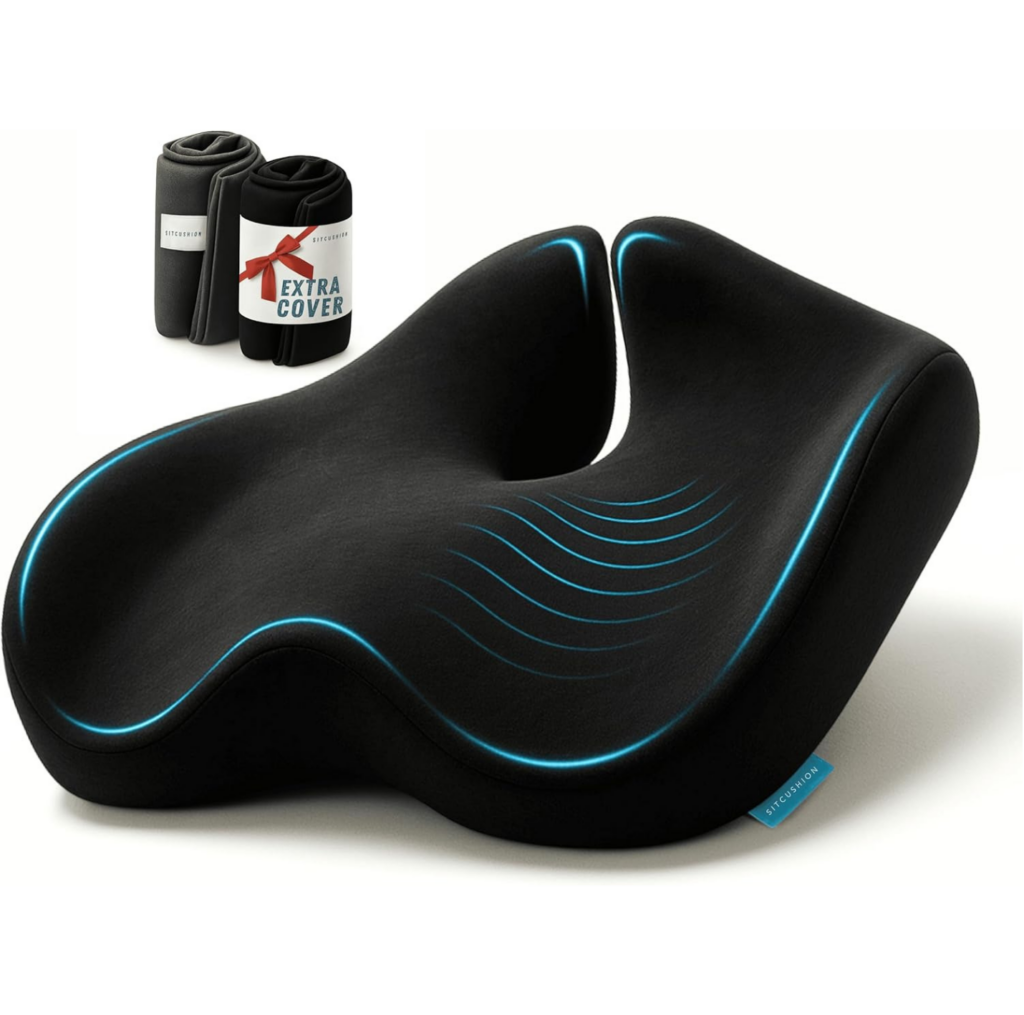
- Size of 17.5″ x 20″ x 5″, unisex, made for all-day office sitting
- Charcoal-infused memory foam with a U-shaped coccyx cutout
- Non-slip base, built-in carrying handle, and a removable, washable cover
- Backed by a lifetime money-back guarantee
Sit Longer and Feel Better at Your Desk
The sitcushion Office Seat Cushion adds pressure relief and a U-shaped tailbone cutout to your office chair, backed by a lifetime money-back guarantee.
Simple Habits That Make Long Sitting Easier
Comfort during long workdays comes from how often you change position, not from one perfect posture. Stand up, walk, or stretch in short, regular breaks, and use a reminder if you tend to forget. Our sit-stand-move rule guide gives a full break schedule you can follow. Even slow walking or standing during a phone call counts as movement, in line with the WHO advice to limit sitting and replace it with movement of any intensity.
Frequently Asked Questions About Sitting More Than 6 Hours a Day
Is sitting more than 6 hours a day bad for you?
It can be, mostly when you sit for long stretches without moving. Long sitting is linked to more back discomfort and a higher risk of several long-term health problems. Regular movement lowers that risk, so how often you break up your sitting matters as much as the total hours.
How many hours of sitting is too much?
There is no exact safe number. The WHO advises adults to limit sitting time and replace it with movement of any intensity, without setting a specific hour limit. If you sit 6 hours or more, focus on breaking it up and making those hours more comfortable.
How can I sit comfortably for long hours at work?
Start with your setup. Keep your feet flat on the floor or a footrest, your back supported by the backrest, your monitor at eye level, and your thighs roughly parallel to the floor. Then change position often. Our proper sitting position guide covers each adjustment.
How often should I get up when I sit all day?
Aim to get up at least every 30 to 60 minutes, even for a minute or two. Short, frequent breaks work better than one long break. For a ready-made schedule, follow our sit-stand-move rule guide.
How can I test seating comfort for long hours of work?
Check in at 30 minutes, 2 hours, and near 6 hours. Note where you feel discomfort first, such as the lower back, tailbone, hips, legs, or neck. That spot points to the likely cause. The comfort test table above lists the first fix for each.
Can a lumbar support pillow help when sitting for long hours?
Yes, for lower back support. A lumbar pillow fills the gap between your lower back and the chair. It does not relieve pressure under your hips and tailbone, which is what a seat cushion is for. Many people use both, see lumbar pillow vs seat cushion.
Does a seat cushion help if I sit all day?
It can, if your chair is already set up well but you still feel pressure in the tailbone, hips, or sit bones. A cushion adds pressure relief and a tailbone cutout. It works best alongside regular movement, not instead of it.
Can exercise make up for sitting all day?
It helps, but it does not cancel out the effect. Research found that risks from sitting were smaller in people who were more active, but not gone. Exercise and regular breaks during the day work best together.